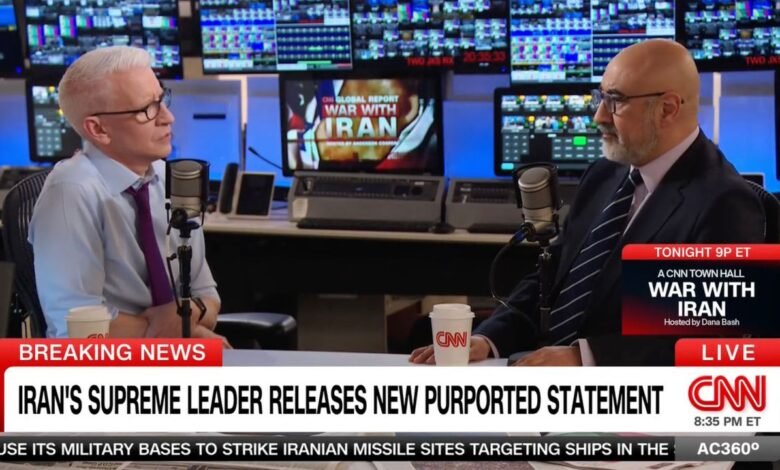
Last week, CNN rolled out some experiments in form and in manufactured authenticity. Anderson Cooper wore his sleeves rolled up for a roundtable discussion among a clutter of clunky microphones on a desk; Jake Tapper recorded a show from his home office, near a clothes rack of dress shirts and blazers, and talked about bringing viewers to the actual desk where he and his team do their journalism. The impression wasn’t particularly subtle—someone had obviously suggested that the network try to make its shows look more like the podcasts that millions of people now watch on YouTube or see clips of on TikTok and Instagram—and it certainly didn’t succeed in making CNN come across as more trustworthy or natural, which was presumably the goal. It felt like watching Ronald Reagan take off his shirt, paint on some jeans, and start screaming like Jello Biafra. The podcast industry’s currency, deservedly or otherwise, is oppositional: people don’t listen to Joe Rogan because they think he’s better at his job than CNN; they do it because they hate CNN.
The podcast aesthetic—casual, long-winded, sometimes profane—directly opposes, perhaps not coincidentally, the sterility and bizarre right-this-minute quality of cable news, on which everything seems incomplete and therefore manipulative, and yet somehow endless. The visual style of podcasts is purely functional, with the pandemic-inspired appearance of remote work: people are talking at you from boxes on your screen. I record my podcast, “Time to Say Goodbye,” in my basement, and have a pretty standard setup: a Shure SM7B microphone, my daughter’s art work in the background, poor lighting because why bother, and some soundproof foam panelling that’s slowly peeling away from the wall. My co-host, Tyler Austin Harper, sits in front of a bookshelf in his home office. Over the dozens of episodes we’ve recorded together, we’ve never changed the “look” of what we’re doing, because we understand that nobody really cares. Just as the best talk radio feels like a phone conversation you’re having with a friend, we want the podcast to seem like a slightly unhinged Zoom call you’re having with your annoying cousins who won’t stop ranting about why the Democrats keep losing.
But, in the past few years, podcasts have trended toward what we can loosely call professionalization, which made CNN’s recent effort even odder. The COVID-era signature of bookshelves in the background and plug-in USB microphones in the foreground has slowly given way to generic studios featuring some decent wood panelling and a couple of plants. Webcams, which produced a washed-out and slightly pixelated image, have been replaced by stand-alone video cameras that capture podcasters in deeper and richer tones. (This is one reason that so many of the big podcasts you see these days look like they borrowed the dark and moody interview sets of “Wild Wild Country.”) I doubt that these production changes will erode the supposed authenticity of an already beloved podcaster, but I also don’t see any likely benefits. Kylie Kelce, who hosts the enormously popular podcast “Not Gonna Lie,” splits her time onscreen between a standard Zoom square with her kids’ art on the wall behind her and a studio where she sits on a beige couch and talks to her guest in person. To someone who watches her clips on Instagram, there’s no meaningful difference.
What happened in podcasting is that money arrived, and some of it went into producing video clips. (“Not Gonna Lie” was created by Wave Sports & Entertainment, which produces and distributes content that features popular athletes.) Now, whenever any new media venture is launched, a whole lot of people with related experience get hired, and they start buying equipment, renting studio space, and booking production time. There’s also an acquisition war going on, with podcasts such as the sports-chat show “Pardon My Take” moving to Netflix, which might demand higher video quality than social media. Previously, the credibility that podcasters enjoyed stemmed from their opposition to mainstream media, and the low-tech and intimate videos reflected this. Today, all the professional podcast sets look similiar—a table of microphones, some swivelly mid-century-modern chairs, a dark wall—and they convey nothing at all, really. As the industry has expanded its budgets, and added more line items for improved production, the aesthetic currency of the old D.I.Y. podcast look has decreased. CNN’s experiments in information populism, then, feel doubly tragic: the network isn’t fooling anybody, and it has also misdiagnosed the value of its appropriation, like the kid putting on a Misfits shirt after Hot Topic popped up in every mall in America.