
A quantum computing system’s perfect randomness could keep your secrets safe
Generating and confirming the randomness of qubits could lead to breakthroughs in computer data encryption
The orderly flow of information around the globe depends a lot on security, and at the heart of that security is randomness.
Modern-day encryption relies on unpredictability to avoid being cracked, and the most powerful form of unpredictability is randomness. And in a new study, researchers describe a new way to amplify that randomness.
Random number generators have been around for ages, but they often have subtle imperfections that cause patterns to emerge. And even powerful computers are saddled with this liability purely because they use traditional transistors to generate the binary code—1’s and 0’s—that enables computers to store data and make calculations.
On supporting science journalism
If you’re enjoying this article, consider supporting our award-winning journalism by subscribing. By purchasing a subscription you are helping to ensure the future of impactful stories about the discoveries and ideas shaping our world today.
“Any conventional electronic device like a phone or a computer is completely deterministic, so it’s actually very difficult for a computer or any other electronic device to generate a random value,” says Renato Renner, a physics professor at the Swiss Federal Institute of Technology Zurich (ETH Zurich) and a member of the research team. “It cannot just toss a coin because everything that goes on in the scale of the logic is basically completely predictable.”
While these numbers may seem random at first glance, a quantum computer would be able to recognize even the most obscure patterns and thus crack the code.
“Unpredictability is very important because that’s what the adversary would do to attack it—to just try to predict parts of that password or even the full password or parts of the key,” Renner says.
That’s where the new system comes in. Qubits, the basic components of information in a quantum computer, don’t exist in a binary. Instead qubits have an infinite number of states in which they can exist and only collapse into a single state when their position is measured. In a paper published in Nature on Wednesday, Renner and his colleagues describe how a two-qubit system could generate true randomness.
The scientists entangled two qubits kept at temperatures near absolute zero at the opposing ends of a 30-meter-long tube. When the two qubits were entangled, they shared the same positioning—in other words, if you measured both, you’d get the same output. The long tube was necessary to ensure enough physical separation so that no outside variables could bias the results, Renner says.
“To really be sure that it’s not predictable, I need to have a process where I’m really sure that this process is not described by classical physics,” Renner says.
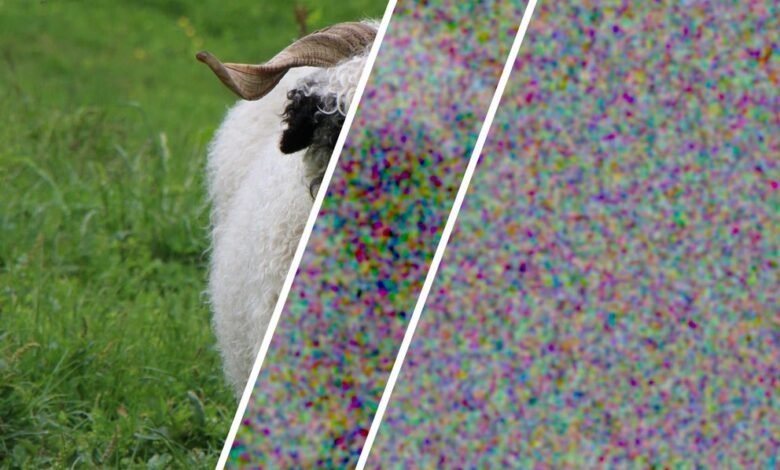
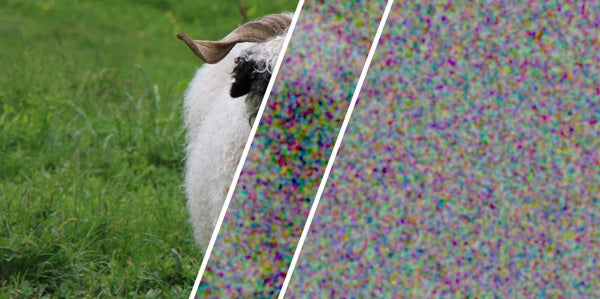
In one experiment, a photograph of a sheep was run through the system, and its pixels were translated into randomness. The resulting mess of colors and splotches would be impossible to put back together, even using a quantum computer, according to the research.
To further test their system, the researchers ran what’s known as a Bell test, which analyzes a quantum system for any hints it might be affected by classical physics.
“Our setup is one that allows you to run many Bell tests with good quality and at a fast rate,” says Andreas Wallraff, Renner’s colleague at ETH Zurich and a co-author of the study. “For our experiment, we ran about a billion and a half of these Bell tests to create certifiably random outcomes that then are used in an algorithm that Renato and his team had developed to create this certified randomness.”
While previous experiments have been able to generate randomness, Renner says the inclusion of a second qubit as a verification measure is new. That development enhances trust, another essential component to solid encryption.
Commercially available quantum computers are still a long way off, but the real-world implications of Renner and Wallraff’s work are relevant now. Renner notes that there’s an entire Wikipedia page dedicated to hacks that were only possible because of imperfect cryptographic randomness.
“This is the problem we solve, which is a current problem, not only a problem in the post-quantum-cryptography era,” he says, “but of course, it will remain a problem.”
“I think cryptography will always rely on good randomness, independently of whether it’s now cryptography against conventional adversaries or future quantum adversaries,” he adds.
It’s Time to Stand Up for Science
If you enjoyed this article, I’d like to ask for your support. Scientific American has served as an advocate for science and industry for 180 years, and right now may be the most critical moment in that two-century history.
I’ve been a Scientific American subscriber since I was 12 years old, and it helped shape the way I look at the world. SciAm always educates and delights me, and inspires a sense of awe for our vast, beautiful universe. I hope it does that for you, too.
If you subscribe to Scientific American, you help ensure that our coverage is centered on meaningful research and discovery; that we have the resources to report on the decisions that threaten labs across the U.S.; and that we support both budding and working scientists at a time when the value of science itself too often goes unrecognized.
In return, you get essential news, captivating podcasts, brilliant infographics, can’t-miss newsletters, must-watch videos, challenging games, and the science world’s best writing and reporting. You can even gift someone a subscription.
There has never been a more important time for us to stand up and show why science matters. I hope you’ll support us in that mission.