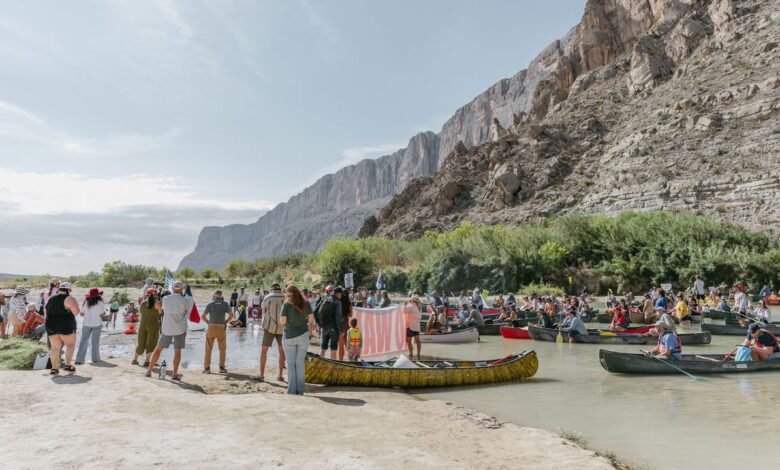
I followed Miller’s van to his property in Redford, where a banner hanging on the gate read “Governor Abbott: PLEASE STOP THE BORDER WALL!! Thank you for your attention to this matter!” Miller lives in Terlingua and uses the Redford land as a place to camp, and as a put-in for river trips. He and his wife had been planning to build a cabin and retire on the property.
Like other landowners I spoke with, Miller said his understanding of where the wall would go largely came from a map on the Department of Homeland Security’s website. A dark green line marked where the government planned to build a “primary border wall system,” while an orange line indicated “detection technology” but no physical barrier. Earlier this year, the line was mostly green, meaning that a steel wall would traverse much of Big Bend National Park and Big Bend Ranch State Park. After sustained public outcry—“stop the steel” was one slogan—the colors on the map changed: the line crossing the national park and part of the state park was colored orange. Miller’s land, which abuts the state park, was still in the green zone. But there was pervasive uncertainty about whose land would be affected, and how. “The only way to get this information is by refreshing the website and seeing what color it is,” a frustrated landowner told me. The map has changed multiple times over the past month, and at one point was removed from the website entirely. In mid-May, the head of C.B.P. said that the administration no longer planned to build a wall within the national park. The current map indicates “technology & patrol roads” and “vehicle barrier systems” within the park’s boundaries, and a steel wall elsewhere in the region, including parts of the state park.
Miller drove past a thicket of mesquite and parked on a bluff with patchy, sun-bleached grass. The Rio Grande was twenty feet away, shining between stalks of river cane. Though many people come to far West Texas for its isolation—the Unabomber’s slightly less reclusive brother did a stint here in the eighties, living at first in a crude underground shelter—Miller said that immigration-enforcement agents have been an intrusive presence for many years. “In the Obama days, they deported a lot of our friends out here—people who were raised in Terlingua,” he said. During the second Trump Administration, the federal government sent the military to the area; for a little while, there was a Stryker tank parked across from his property. On multiple occasions, he said, he’d found game cameras that border patrol had hidden in trees, to keep an eye out for illegal activity. (A spokesperson for C.B.P. noted that the agency was entitled to patrol on private lands within twenty-five miles of the border, and said that “when installing technology such as cameras on private property, the Border Patrol coordinates directly with the landowner. That was done in this case.” Miller said the agents had not coördinated with him.)
As Miller relayed this story, the sound of a vehicle coming down the dirt road interrupted him. “Here we go,” he said, rolling his eyes. A green-striped Border Patrol vehicle pulled up, and two agents got out, both wearing sunglasses and black tactical vests. “Just seeing if you guys are O.K.,” one said. (The agents declined to give their names.)
“We’re just talking about how they’re trying to build the border wall . . . and it’s supposed to basically steal all our property,” Miller said brightly, a glimmer of anger in his voice.
“Yeah, unfortunately, it’s gonna happen—” the agent started to say.
“It’s not going to happen,” Miller said. “Not if we can do anything about it.”
Building the wall in the area was “unfortunate,” the agent conceded, but it would help stop child sex trafficking. “Nobody wants that, right?” he said.
“Is it worth billions of dollars to stop a handful of people?” Miller asked.
“If it stops one child from getting sex trafficked, yeah, for me, it is,” the agent said stiffly. “We’re trying to make a difference.”
“It’s going to make a difference,” Miller said bitterly. “Like, the most horrible difference you can imagine.”
After the agents drove off, Miller walked down to the riverbank and stood looking out at the Rio Grande. It was a muddy green and moving quickly after some recent rain. Miller’s dog, Koozie, waded in the water up to her belly. Lately, the wall had been appearing in his dreams, Miller said. Sometimes he was on the river and the wall blocked him from reaching the shore, and sometimes he was on land and couldn’t find his way to the water. I asked him what he thought was going to happen. “I think they’re going to build the wall,” he said.