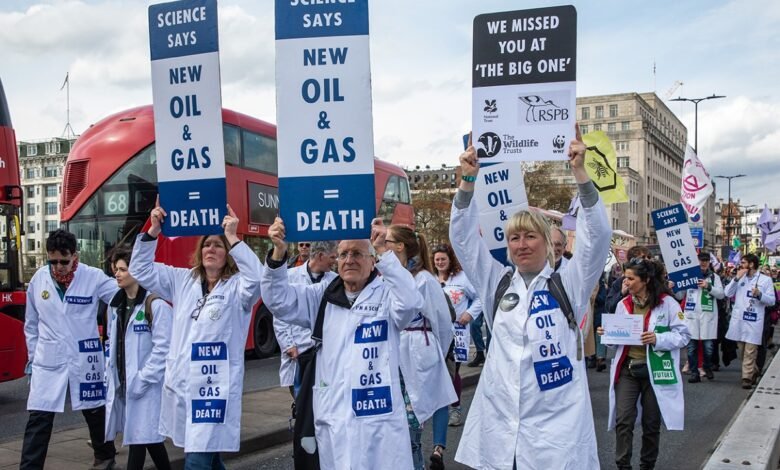

Scientists can send confusing messages when they mix evidence and political beliefs.Credit: Mark Kerrison/In Pictures via Getty
Many countries are in a crisis of trust. In the United Kingdom, polls show deep distrust in politicians. Trust in business, journalism, the police and the judiciary is falling, too. But, one institution still commands broad respect: science. Politicians have a net trust score of −75%, whereas scientists have a score of 58%.
When people are asked what makes them optimistic about the future, the top three answers are medical advances, new technology and research and innovation. In fourth place: nothing. These findings, from UK research undertaken this year by the global charitable foundation Wellcome and polling organization More in Common in London (see go.nature.com/4vqskh3), suggest that at a time when the public can feel divided and despondent, science is a rare source of shared optimism and even pride.

Have people stopped trusting science? The data tell a surprising story
But that standing is more fragile than it looks. More in Common’s seven-segments model, which groups people according to measures of their underlying values and world views, can spot shifts in trust that headline polling can miss. Much of what was found is reassuring: many institutions would envy the trust that science enjoys. But there are clear signs of strain, and, for some groups, confidence has given way to wariness.
Of those polled, 34% said that they trust science ‘a lot’, down from 63% in 2020. And in all seven segments, trust is net positive. Yet, for the most sceptical groups, it is almost 60 percentage points lower than for the most confident.
Most people in the United Kingdom do not think that science is politically biased. But the least trusting groups are most likely to perceive bias — often citing the COVID-19 pandemic as an example — and to say that this has reduced their trust. Public support and consent for scientific research cannot be taken for granted, and the past few years have seen shifts in public opinion in areas that once felt settled.
Six ways to put the public at the heart of science and policy
This deserves attention. The United Kingdom is not the United States, where trust in science has become polarized by political identity. But there are warning signs. Those who do perceive political bias are twice as likely to say that it is to the left rather than right. Right-leaning segments tend to be less trusting than those that lean left or are centrist.
Strikingly, scientists are concentrated in the two most left-leaning segments. UK scientists are more left wing than is the UK public.
Among the public, 12% are classed as ‘progressive activists’, strongly motivated by social justice and global issues, and 21% are the more moderate ‘incrementalist left’. In the Wellcome poll of 142 scientists (a small but meaningful sample), nearly 40% were progressive activists and another 26% were incrementalist left. Two-thirds of scientists lean left, compared with one-third of the wider public. Just one-fifth of scientists fall into the three most conservative segments, compared with around half of the public.