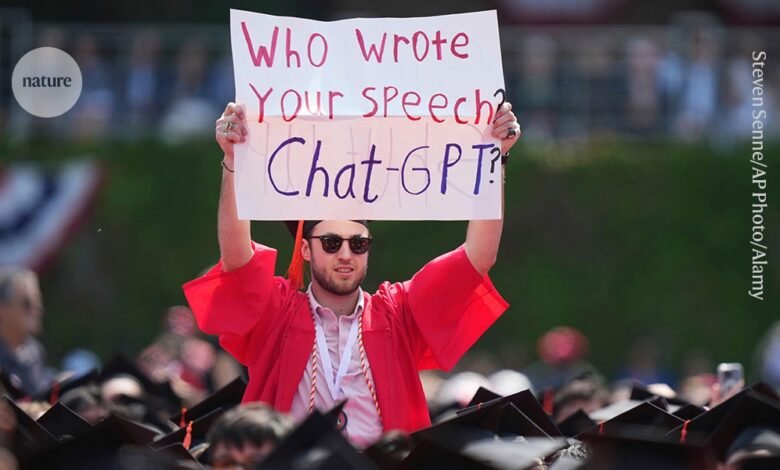
During this year’s graduation season, several ceremonies in the United States turned unexpectedly tense when speakers raised the topic of artificial intelligence. At the University of Arizona in Tucson, former chief executive of Google, Eric Schmidt, was booed while discussing AI and technological change. Speakers at the University of Central Florida in Orlando and Middle Tennessee State University in Murfreesboro received similar treatment.

Meet the academics refusing to use generative AI
It’s hard to dismiss these incidents as the fault of a single speaker or the response of an unruly crowd. What the incidents point to is a broader disconnect. Institutions and technology leaders constantly present AI as an inevitable tool for increasing productivity and competitiveness, whereas members of Generation Z (Gen Z) — typically defined as those born between 1997 and 2012, including many of today’s students — seem to be experiencing it as a force that has a cost, especially to their learning. They also see it as arriving faster than the social and political systems that will be needed to manage its consequences.
The prevailing disconnect became more concrete to me when I read the student evaluations for the undergraduate course that I developed and teach on energy, environment and climate. In response to my permissive AI-use policy, which presents emerging AI tools as potentially useful aids for learning, one student wrote that they were disappointed to have attended a class on climate that “takes economic growth and technological progress as inevitable”.
This moment suggests that the student cohort might be responding to AI’s rapid normalization with a scepticism that many educators, business executives and institutional leaders did not fully anticipate. It is important for universities to pay attention and reflect deeply on how to deploy AI tools, and in what context.
In general, young adults have been early adopters of digital technologies — from the Internet and mobile phones to social media. Many academics, myself included, expected AI to follow a similar path, which partly motivated my favourable and permissive AI-use policy.
Universities are embracing AI: will students get smarter or stop thinking?
However, recent survey data suggest that Gen Z has a more ambivalent relationship with AI. Use is indeed high. In a Gallup survey in the United States in April, 51% of Gen Z respondents reported using generative AI at least weekly, a figure that is largely unchanged from 2025. Yet sentiment shifted noticeably over the same period: excitement and optimism declined, whereas anger towards the technology increased (see go.nature.com/3rpfhzt). For students, whether AI feels useful or worthwhile is closely tied to broader concerns about future employment, the accuracy and verifiability of information and the environmental costs of the infrastructure that powers the technology.