How underappreciated mathematician Emmy Noether helped prove physics’ most fundamental theories

This article is from Proof Positive, our friendly math newsletter that’s delivered to your inbox every Tuesday afternoon. Sign up today and read it first.
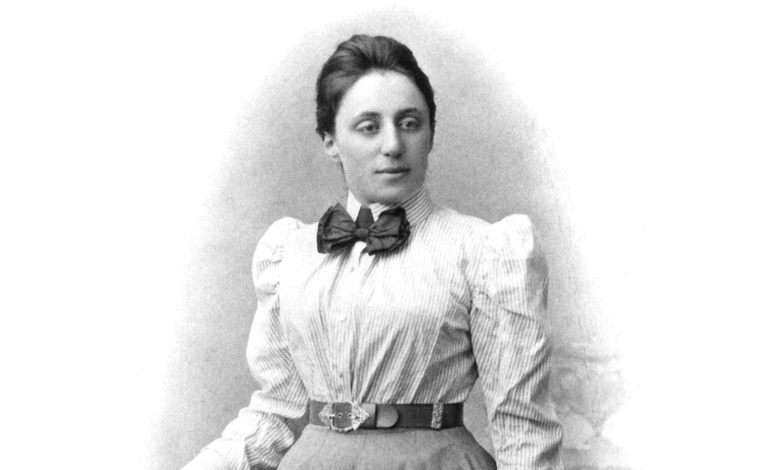
Physicists Isaac Newton, Albert Einstein and Robert Oppenheimer are household names. Their fame has made them cultural icons featured in science and history textbooks. But when you mention the name Emmy Noether, many people shake their heads: “Never heard of her.”
On supporting science journalism
If you’re enjoying this article, consider supporting our award-winning journalism by subscribing. By purchasing a subscription you are helping to ensure the future of impactful stories about the discoveries and ideas shaping our world today.
That is truly a pity because this brilliant thinker revolutionized both mathematics and physics. Her insights form the basis of today’s established physical theories: from the Standard Model of particle physics, which describes the most fundamental particles in our universe, to the theory of relativity, which characterizes the universe at the cosmic and subatomic scales.
What’s so impressive about Noether’s work is that it’s purely mathematical. Unlike physical laws, Noether’s theorem has been formally proven. As long as we believe in the foundations of mathematics, it is valid without exception, which makes the theorem extremely powerful. In the 1950s and 1960s, for example, scientists were able to predict some of the elementary particles—the most fundamental building blocks of matter—simply based on considerations of symmetry.
A world of hidden symmetries
Physicists think of the concept of “symmetry” as a kind of sameness or consistency. Even if you transform something, through rotation or mirroring, for example, symmetry means that its fundamental properties remain unchanged.
Noether discovered that for every continuous symmetry of a system, there is a conserved quantity—that is, a quantity that remains unchanged over time. Consider, for example, a car traveling along a straight country road. Let’s assume that the wheels on the road generate no friction and roll without engine power. Once given a push, this car continues to travel indefinitely. If you move the vehicle 10 meters forward or backward, nothing changes: the scene is symmetrical with respect to displacement.
According to Noether’s theorem, there is therefore a conserved quantity, which, as it turns out, is momentum, the product of mass and velocity. This means that the vehicle cannot possibly gain or lose speed from “nothing,” because momentum is always the same. If the road is crisscrossed with mountains and valleys, however, the situation changes. If you move the vehicle in this landscape, it might now be traveling uphill, even though it was previously traveling downhill. The system is no longer symmetrical with respect to displacement, and therefore, momentum is no longer conserved: the vehicle moves faster downward, while it takes longer to move upward.
Another classic example among physics students is the elastic collision of two spheres: two spheres roll toward each other, collide and then move away from each other. To determine the velocities of both spheres after collision, physicists use the fact that the total energy and momentum are the same before and after the collision. In other words, we assume the conservation of energy and momentum. Noether’s theorem demonstrates that this assumption holds true.
There are other continuous symmetries. Satellites orbiting our planet are rotationally symmetric. Their position in orbit is irrelevant as long as their distance from Earth remains constant. The resulting conserved quantity is angular momentum. Furthermore, many other symmetries, and thus conserved quantities, can be identified, although these are more abstract: for example, the phase in the wave function of a quantum mechanical object.
What few people know is that Noether didn’t produce just one extremely important theorem for physics but two. The second theorem concerns somewhat more abstract forms of symmetry, which are particularly relevant in particle physics.
Noether’s work on these theorems focused physicists’ attention on symmetries and the related field of group theory, which proved extremely helpful in the development of the Standard Model of particle physics. But Noether also contributed to explanations in the theory of relativity.
In 1915 her colleagues, mathematicians David Hilbert and Felix Klein, sought her out because they had noticed that energy was apparently not conserved in Einstein’s recently published general theory of relativity. Knowing that Noether was an expert in this area, Hilbert and Klein approached her with this puzzle. This question led the mathematician to develop her theorems. And she was able to answer the riddle: No, energy is not conserved in Einstein’s general theory of relativity, because time is not a static quantity. Time can be stretched and compressed. Therefore, energy conservation only applies under certain special cases.
Despite the enormous importance of her work and her excellent reputation among mathematicians, Noether never held a permanent academic position. As a woman, she constantly had to fight for recognition—even though she had extremely renowned supporters, including Einstein and Hilbert. And even today she has unfortunately not achieved the fame she truly deserves.
Noether also faced many challenges because of her Jewish roots. She was born Amalie Emmy Noether in Erlangen, in what was then the Kingdom of Bavaria in the German Empire, in 1882. Likely influenced by her father, who was a prominent mathematician at the time, Noether began auditing mathematics classes at the University of Erlangen. A few years later, Bavarian laws changed to allow women to become full students at universities, and she was at last able to enroll.
After completing her doctorate, she remained at the university for another eight years, albeit unofficially, although she substituted for her father in lectures. In 1915 Hilbert and Klein finally invited her to Göttingen, and they advocated for her to receive a teaching position at the university there. It took another four years before she would be approved as a female lecturer, and even still, she received no remuneration for years afterward.
Yet by all accounts, Noether loved mathematics and contributing to the field. She even shared ideas with colleagues, some of which would spur significant new insights into topics such as algebraic topology. Many of her students would go by the name “Noether boys” and had their own successful careers.
In 1932 she was the first woman to give a plenary lecture at the International Congress of Mathematicians in Zurich. The following year, she was expelled from Germany as one of many Jewish professors who lost their positions after Adolf Hitler came to power. She relocated to the U.S., taking a position at Bryn Mawr College, where she taught the “Noether girls” for two years before her death at age 53, after surgery to remove a large ovarian cyst.
Now that we’ve introduced Noether, in next week’s newsletter, we’re going to lean into some of the core concepts from calculus and physics that allowed her to develop her groundbreaking theorems.
This article originally appeared in Spektrum der Wissenschaft and was reproduced with permission. It was translated from the original German version with the assistance of artificial intelligence and reviewed by our editors.