Blue has always known how to carry more than one meaning.
It is the color of midnight velvet, an old-school tuxedo lining, bruised vulnerability, and the kind of New York night that knows how to dress before making a point. Presented by The Blue Jacket Fashion Show, Blue Ball 2026 brought that symbolism into sharp focus, benefiting Man Cave Health and honoring designer Frederick Anderson at Nebula in New York City.
The title, of course, carried its own discreet wink. For a subject men too often avoid until discomfort becomes impossible to ignore, that small release of humor felt rather useful. The evening did not cheapen the mission. It gave the room permission to enter it.
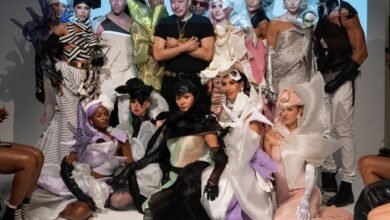
That balance is, perhaps, exactly what makes The Blue Jacket Fashion Show so effective. Founded in 2016 by Frederick Anderson and Laura Miller, the platform was created to bring men’s health, especially prostate cancer education, into public conversation through fashion, visibility, celebrity, and culture. The blue jacket became more than a garment. It became a signal: elegant, masculine, photographed, impossible to dismiss.


This matters deeply. Men’s health still lives behind too much silence. Too many men delay screenings, minimize symptoms, avoid physicians, or confuse endurance with strength. Prostate cancer awareness and early detection are not abstract talking points. They can shape outcomes, families, futures, and the private structure of a life. Man Cave Health meets that resistance directly, making education, access, and support feel less clinical, less shaming, and, ideally, far more possible.
The organization’s work understands something essential: care must be made approachable before it can become habitual. A man may not always respond to fear, statistics, or medical language. He might, however, respond to a room, a jacket, a friend, a public figure, a performance, a glamorous evening that quietly insists prevention is not weakness. It is intelligence.
Of course, a cause rarely moves culture by behaving like a pamphlet. Sometimes it needs a stage. Sometimes it needs a bass line. Sometimes, rather beautifully, it needs Lion Babe.
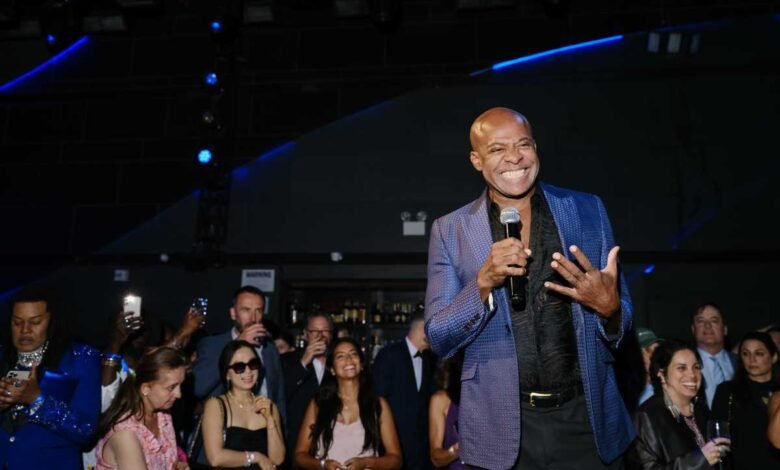
Held at Nebula on West 41st Street, the fundraiser had polish without stiffness, glamour without emptiness, and enough nightlife charge to keep the message from feeling medicinal. The room reflected a very New York collision of fashion, entertainment, philanthropy, media, sports, and society. Expected names included A-Trak, Chromeo, Blu DeTiger, Charity Lawson, Kelly Bensimon, Mario Cantone, Ty Hunter, Nigel Barker, Ramona Singer, Mike Woods, Dante Hall, Carlos Greer, and more.


Honoring Frederick Anderson gave the occasion its proper center. Anderson’s work as a designer has always carried a beautiful respect for the body: its movement, sensuality, discipline, and ease. His role in building the Blue Jacket movement adds another layer. He has helped prove that style can do more than flatter. It can focus attention, shift language, and turn a difficult medical conversation into a cultural one.
That is no small accomplishment. At its best, fashion gives visibility to what a society is still learning how to say. In this case, the message was clear: men deserve to talk about their bodies before crisis, before fear, before silence becomes expensive.
Young Paris shaped the sound of the night, while Lion Babe brought command, beauty, and that particular cool that makes a performance feel less like entertainment and more like atmosphere. Crystal Waters then gave the room a flash of dance-floor history, the kind of instant recognition only a true club voice can deliver. Her presence added joy without dissolving purpose, which is a difficult thing to do well.
Afterward, guests moved onto the stage and began dancing. The moment felt, perhaps, like the correct conclusion. The cause had been named. The crowd had listened. The music carried the rest.


That is where the evening found its charm. Men’s health was not hidden beneath glamour. Glamour served it. The party did not soften the seriousness of the issue into something disposable. It made prevention, screening, vulnerability, and care feel social, visible, and urgently human.
Blue Ball 2026 made a strong case for what modern advocacy can become when it refuses to be dull. It was cause with boom: elegant, cheeky, generous, and alive enough to make the message survive morning.
Men’s health deserves that kind of attention. It deserves funding, language, humor, beauty, access, and rooms where silence finally loses some of its power.
The evening gave the conversation a stage. Quite naturally, New York danced on it.