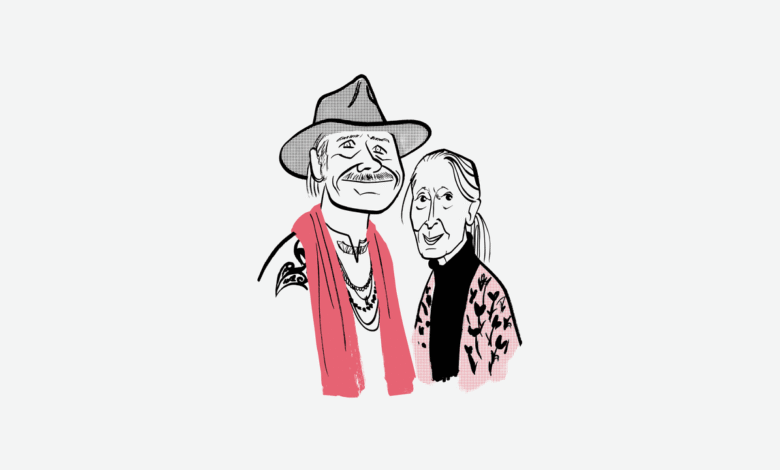
His Excellency the Reverend Patrick McCollum, a peace activist from California_—who, according to an Indigenous South American prophecy, will unite all the people of the Amazon in order to save the region (and thereby the world) from destruction—_was near the Battery Park City ferry landing the other day when he got a call with sad news. “Jane died,” he reported, a little teary, after he hung up. “Jane Goodall, one of my closest friends.” McCollum and Goodall happen to star in a documentary that comes out this week by the director Gabe Polsky, “The Man Who Saves the World?,” which details McCollum’s efforts to fulfill the prophecy. In the film, Polsky seems unsure whether to view McCollum as a saint or a wack job. (An investigator Polsky hired found that most of McCollum’s claims are “true or have a basis of truth,” but that some “cannot be fully corroborated.”) Then he interviews Goodall, who calls McCollum “probably the most extraordinary person I’ve met.”
“I had a special and a different relationship with her,” McCollum said. They were supposed to meet up in a few days for what Goodall, who was ninety-one, was calling farewell drinks. “The work we do sounds glorious, but it’s very hard,” he went on. “It’s nice to have someone who understands that. She’s the one I called, and I’m the one she called. It’s just that I will never be able to call her again.” He said that she’d willed him some of her ashes.
A few hours earlier, McCollum, who is seventy-five and wore a kurta and an Indiana Jones-style hat, had visited the National Museum of the American Indian. At a metal detector, a guard gestured to his many necklaces and pendants. “Can you remove that stuff, or is it sacred?” the guard asked.
“Deeply sacred,” McCollum said.
He did an inventory. “I made this myself,” he said, lifting up a medallion. (“I was once a jewelry designer—I did stuff for the Queen of England,” he explained.) “In India, there was the largest gathering of humans in history, and I was given the honor of blessing the Ganges for a hundred million people. Had to clean their karma. The gurus decided this pendant is what I should do it with.” He fingered another necklace. “This was given to me in the Amazon by the Jaguar People. They believe in the prophecy. This—the first war I ever stopped was in Africa, and this necklace designates me as a chief and a king of a small region. This one, long story. I met a maharaja.”
He spread his arms to get wanded. “You’re good,” the guard said.
McCollum’s peace work is difficult to define. He gives out business cards that say, “Creating peace on a universal scale through promoting a meta-narrative, which establishes that everyone and everything is sacred and essential.” With the world being what it is, it’s a busy time in the universal-scale-peace business, but when is it not? “I’ve got a lot of stuff going on,” McCollum said. “I’ve got my Amazon things. I’m one of the co-leaders organizing what’s called the State of the World Forum.” It was started by Goodall, Desmond Tutu, and other eminences. “I’m kind of taking Gorbachev’s place,” he said. He’s also working with an A.I. group that he says analyzed his brain: “To create a baseline for A.I. that would only do things I would do. You know, so that they wouldn’t kill people and such.” So far, he hasn’t fund-raised. “I finance ninety per cent of everything I do with my Social Security,” he said.
Where does he find the energy? “My life centers around my Mocha Frappuccino,” he said.
McCollum had never been to the museum. “All of my trips to New York have been to the U.N.,” he said. “Except when I had to meet Modi at Madison Square Garden.” He breezed through the exhibits, then struck up a conversation with a security guard.
“This section is mainly South America,” the guard said. “I was born myself in Guyana. My dad was a parachute instructor for the G.D.F., the Guyana Defence Force. The parachute-jumping was in the Amazon. I was actually fortunate to meet the Waiwais.”
“I know them,” McCollum said.
“I spent two years with them,” the guard said. “They taught me how to make fishing rods, light fires, clean dirty water.” He went on, “We’re drifting further from nursing planet Earth. In Guyana, we spent every Saturday in the back yard, with a fork, shovel, seeds. When I came to America, I realized everyone is planting with gloves. You can’t use a glove. You’ve got to feel the dirt.”
“So, I’m the person who’s running the largest project in history to save the Amazon,” McCollum said. “Everything you’re talking about, I fully understand.”
He gave the guard a card. “This happens all the time,” he said later. “That guy, at some point, will text me or e-mail me, and I will connect him with other people. Trust me.” He looked energized. He weighed that energy with the death of his friend, and said, “A good day and a bad day.” ♦