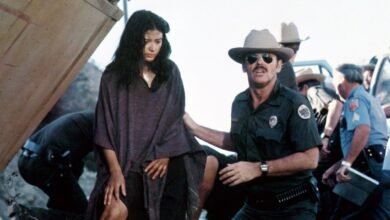
The United States began allowing Japanese people to leave the camps before the conclusion of the Second World War. In December of 1944, the Supreme Court had ruled that the government did not have the authority to detain “concededly loyal” citizens. But many had lost everything during the relocation process and had nowhere to return to. “What kind of poison freedom is this?” a character in “Questions 27 & 28” wonders.
In the decades after the war, Japanese Americans would be hailed as a model minority for their resilience and peaceful reintegration into American life. Yet the truth was more complicated. There’s a moment in Yamashita’s novel when James and Gordon Hirabayashi, two Japanese American academics, walk through a late-sixties demonstration at San Francisco State College, where James teaches. Gordon was a firebrand when he was young, having been imprisoned for challenging curfew and internment orders, but a kind of middle-aged disillusionment has set in. The youth are brash and outspoken, he contends, and “we’re has-been.” But a student activist named Paul, who also appeared in “I Hotel,” recognizes Gordon and shows that their generation views him as a hero. We understand why Paul thinks this. Though ostracized in their time, people who resisted internment are now seen as civil-rights pioneers. In “Questions 27 & 28,” as we read our way through the forties and fifties, we are ever conscious of that passage of time, across hundreds of pages, and of how this distance allows for new stories to be pulled from old materials. Most of us understand that history is often just the victor’s account of how things happened. But the novel’s achievement is that we are forced to experience this insight almost bodily. We feel the weight of the past, all these accumulated voices and perspectives, within and between Yamashita’s novels, as well as the process through which disparate stories, anecdotes, or experiences might coalesce as history.
“In the future,” Yamashita writes, looking at a little girl in a wartime photograph and wondering what she is thinking, “no one will remember this future.” Despite Yamashita’s best efforts, there remain limits to what the “endless labyrinth” of the past still holds. The historical record is often vague when it comes to the capaciousness of our forebears’ imaginations. But Yamashita is entranced by such absences, when fiction allows her to inhabit the dreams of these historical characters. A researcher named Nobuya Tsuchida recalls his work as an interpreter for a peace delegation of survivors of the bombings of Hiroshima and Nagasaki who visited New York in 1964. Tsuchida is assisting two men known simply as the Writer and the Reporter. One afternoon, the delegation visits the home of Yuri Kochiyama, a famed Japanese American activist, and meets her friend Malcolm X. “I have a memory of his tall benevolence,” Tsuchida thinks, yet, decades later, he has not been able to verify this afternoon in anything published by the Writer or the Reporter: “I see now that big history encompasses little histories, overshadows and encumbers. The small matters of small individuals become invisible, pass into oblivion.” Still, he knows it happened. After leaving Kochiyama’s apartment, Tsuchida, the Writer, and the Reporter wander into Smalls Paradise, a Harlem night club, and debate Malcolm X’s politics. “How do we make peace from war?” they wonder, but Tsuchida is already somewhere else, lost in the wail of a saxophone.
We’re always participating in a larger story, even if it’s up to people in the future to make sense of it all. It’s also up to them to decide what genres to use; we don’t choose the conventions we live within. One of the most wondrous chapters in “Questions 27 & 28” imagines a conversation between Michi Nishiura Weglyn, the author of “Years of Infamy,” a 1976 book that helped inspire the redress-and-reparation movement, and Wayne Collins, a civil-rights lawyer who challenged the government’s relocation orders. It’s presented as dramatic dialogue, or maybe as absurdist tragicomedy. “Where are we?” she asks. He surmises that they’re “in the clouds.” It can’t be Heaven, he jokes, because that’s not where he’s supposed to end up. Is it Purgatory? “We’re in the archive,” she realizes. “I loved the archives. I’ve come home.” ♦