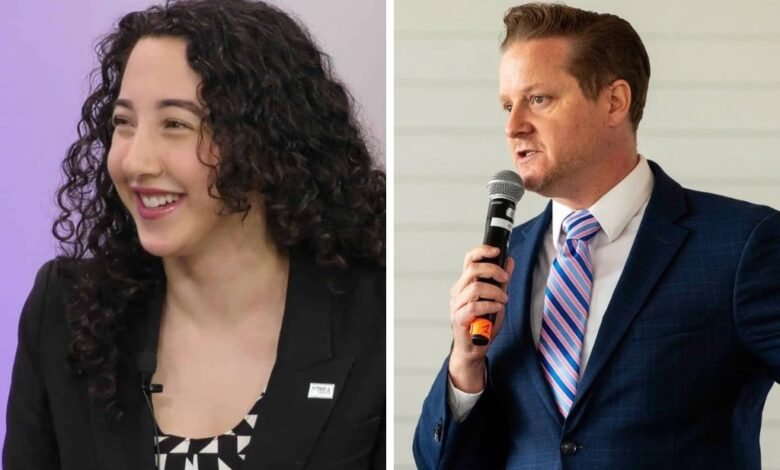

Elissa Frank, J.D., is president at the New Jersey Civil Justice Institute. Tom Stebbins is executive director at the Lawsuit Reform Alliance of New York. Courtesy photos
Courtesy photos
With Robert F. Kennedy Jr. at the helm of Health and Human Services, public health debates have become increasingly saturated with snake oil and junk science. As a practicing trial lawyer and longtime ally of the mass tort bar, Kennedy’s outlandish claims about vaccines and Tylenol come as no surprise to lawyers and court observers who have watched similar theories advanced in court for years. At a moment when pseudo-science is shaping public debate, judges must exercise their gatekeeping role and keep unreliable claims out of court and away from juries.
A consequential case now before the U.S. Court of Appeals for the Second Circuit will test whether federal judges will continue to fulfill that responsibility by barring junk science and unreliable expert testimony from reaching a jury. In the matter before the court, mass tort lawyers have filed hundreds of claims alleging that prenatal exposure to acetaminophen, the active ingredient in Tylenol, causes attention deficit hyperactivity disorder and autism.
The case will ultimately hinge on Federal Rule of Evidence 702, which governs expert testimony. Rule 702 requires judges to examine an expert’s methodology and determine whether the opinion is grounded in sufficient facts or data, rests on reliable principles and methods, and reflects a reliable application of those methods to the facts of the case.
A 2023 amendment to Rule 702 further clarified that the party offering expert testimony must show that every requirement is satisfied. This avoids forcing jurors to sort through scientific disputes that should have been screened out at the outset.
As the recently released “Junk Science Playbook” reveals, research promoting new health risks are often carefully orchestrated by lawyer-backed advocacy groups seeking to manufacture “the appearance of scientific consensus where none exists.”
In a 2021 ruling, the U.S. Court of Appeals for the Fourth Circuit warned us of what happens when gatekeeping erodes. If a court “abdicates that duty by opening the gate indiscriminately to any proffered expert witness,” it risks exposing jurors to “dubious scientific testimony” that can improperly sway a verdict.
In the acetaminophen litigation, U.S. District Judge Denise Cote of the Southern District of New York did exactly what Rule 702 requires. After a detailed review of the record, she excluded the plaintiffs’ key causation experts. Cote found that the experts’ “unstructured approach” allowed for cherry-picking, invited a results-driven analysis, and obscured weaknesses in the underlying data. Without admissible expert testimony on causation, the federal cases could not proceed.
The appeal now asks whether the Second Circuit will preserve that critical gatekeeping or weaken it.
Cote’s conclusion also aligns with much of the medical evidence. Last year, the FDA reiterated that while some studies have reported an association between acetaminophen and later diagnoses, “a causal relationship has not been established” and “there are contrary studies in the scientific literature.” A rigorous review and meta-analysis recently published in The Lancet synthesized 43 studies and likewise found no association with autism, ADHD, or intellectual disability when focusing on stronger study designs.
The U.S. Food and Drug Administration notes acetaminophen is “the only over-the-counter drug approved for use to treat fevers during pregnancy, and high fevers in pregnant women can pose a risk to their children.” Alternatives such as aspirin and ibuprofen carry well-documented fetal risks. When unreliable expert testimony influences litigation, it can distort public understanding and pressure patients toward worse choices.
After a judge excluded the plaintiffs’ experts for methodological shortcomings, the Eleventh Circuit is weighing a parallel dispute over claims that Zantac’s active ingredient causes cancer. Appellate decisions in these cases will help determine whether Rule 702 retains real force.
The stakes are especially high for New Jersey and New York — world leading hubs for life sciences innovation. The proliferation of junk science invites profit-motivated, speculative litigation that undermines research and drug discovery, prevents life-saving treatments from coming to market, and leaves consumers confused and paying more. Strong gatekeeping helps courts focus on meritorious claims while supporting future scientific breakthroughs.
Rule 702 does not ask judges to become scientists. It asks them to ensure that expert testimony relies on sound methods and applies them reliably. The Second Circuit should affirm Judge Cote’s application of that standard. Doing so would protect juries from being misled, promote consistent law, and reinforce confidence that legal outcomes are based on science, not conjecture and speculation.
Elissa Frank is president at the New Jersey Civil Justice Institute.
Tom Stebbins is executive director at the Lawsuit Reform Alliance of New York.