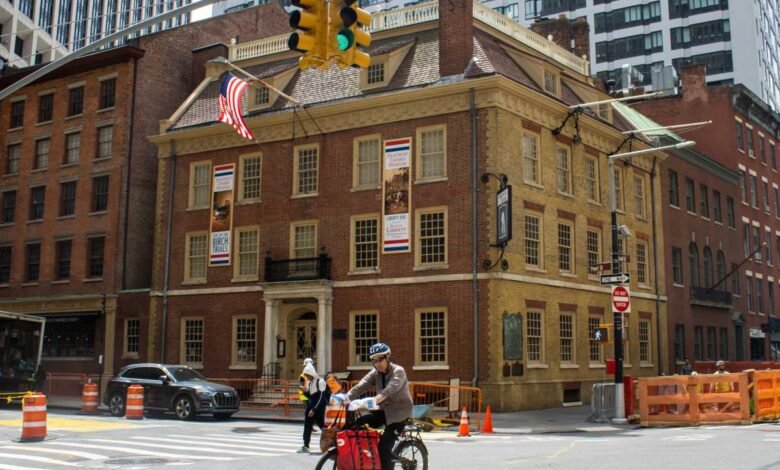
Step inside Fraunces Tavern, and one can’t escape the past. Dusty pine from the wood-beamed ceilings and the smoky aroma of a traditional pub greet visitors. At the corner of Broad and Pearl Streets in the Financial District, one hears only the hum of conversation and the creak of floors worn out by 264 years of footsteps. This is New York City’s oldest bar.
Beyond the whiskey and the old wood, Fraunces Tavern is a breathing time capsule of New York’s earliest days. Established in 1762 by Samuel Fraunces, a New Yorker turned rebel spy, the building now houses both a museum and a working bar. It was a nerve center for the American Revolution, a gathering place for patriots from all social backgrounds to share news and plan acts of protest. Today, it remains a symbol of the city’s resilience. The bar has survived British occupation, commercial neglect, and a 20th-century bombing. It is still pouring drinks.
“I felt like I could feel the history as soon as I walked in the door. It was overwhelming, ” Kathy Fountaine, communications manager for the Fraunces Tavern Museum, said. That history isn’t just in the architecture, but in the way the room forces people together. “Back then, in the long room, they’d all sit together in the same proximity and start chatting.”
While patrons can order drinks and eat on the first floor, the second floor hosts the Long Room, a space that highlights how the tavern originally housed the social DNA of the revolution.
Secret meetings at Fraunces Tavern
Unlike modern bars, where people usually stick to their own groups, colonial taverns were community gathering places. Groups such as the Sons of Liberty, who orchestrated the Boston Tea Party and championed independence, held confidential meetings within the tavern walls.

During the first few months of the Revolutionary War, as the British fired upon lower Manhattan, a warship named the HMS Asia fired a cannonball through the roof of the tavern on August 23, 1775. But the true test of the building’s resilience followed during the Battle of Brooklyn in 1776, the first major conflict following the signing of the Declaration of Independence. The patriots in the bar knew the British were coming because they could see the fleet. The sight of the British Navy, the most powerful maritime force in the world, staging a full-scale invasion left little doubt about what was coming.
“They were outnumbered, and a lot of them were young, maybe 19 years old. And the night before the battle, they were out writing their wills, thinking, ‘I’m gonna die tomorrow.’” Melissa Lauer, the museum’s public programs, said. “What are their odds?”
The Battle of Brooklyn eventually became the largest battle of the entire war. New York was geographically essential, referred to as the key to the continent because its position on the river would allow the British to split the New England colonies from the south. The British kept on encroaching, pushing the Continental Army to the brink of complete collapse at Brooklyn Heights. Thousands of soldiers had already been taken captive. The revolution was saved by a desperate maneuver, known as the retreat to victory” where Washington led the rest of his army under the cover of darkness and thick fog across the river into Manhattan to escape.
“Everything could have ended if things had just gone a little bit differently,” Fountaine said “Get the rest of the army, get George Washington, get his officers, who is left to rebel?”
The fighting spirit
While Washington and his men narrowly escaped the British during the retreat to victory, Samuel Fraunces was not as fortunate. He attempted to escape into New Jersey, but was captured and brought back to British-occupied New York. As a tavern keeper, the British commandeered his skills and appointed him their chef.

“He realizes that this puts him in a position where he can listen to what officers are saying and get that information as a spy out and try to get it back to the Patriots,” Lauer said. “And while he’s doing it, he’s cooking. He’s got access to food. He’s working to smuggle that to some of these other prisoners.”
The building itself is a testament to a fighting spirit. After enduring damage during the Revolutionary War, the tavern fell into a long period of commercial neglect and was nearly demolished. Its survival was only guaranteed when the Sons of the Revolution bought it in 1904. It withstood a 1975 bombing attack and a flooding during Hurricane Sandy in 2012.
But one of its most famous dates was December 4, 1783. On that day, George Washington gathered his military officers in the Long Room and bid farewell to his troops. The war was over.
“New York City has this reputation of forgetting its history. You’re always building something new, you’re tearing down the old. But I think all the time we’re building upon a foundation,” Lauer said. Upstairs, the museum keeps what’s left of the man behind the myth. “He died with only one of his permanent teeth left and you see his hair and the chamber pot. He was a real person.”