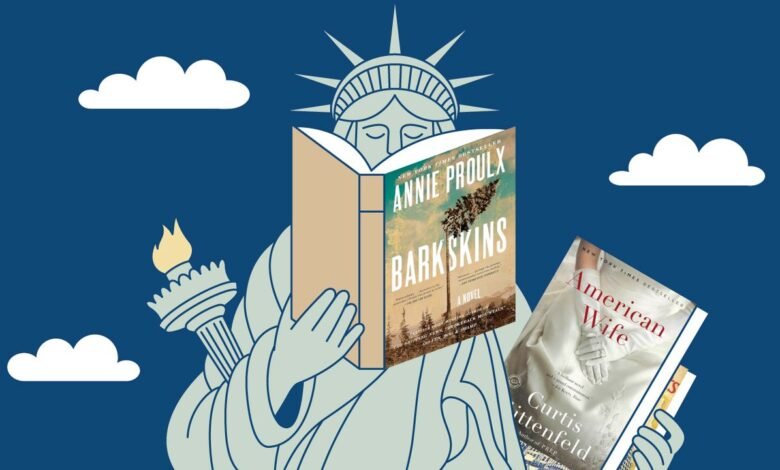
You know what they say: a semiquincentennial happens only once, but great American literature is forever. Whether we can all agree on what makes a novel a great American one is another story (considering we can’t agree on much these days). To me, Curtis Sittenfeld’s “American Wife” fits the description. It’s the fictionalized story of Laura Bush’s life, about a woman married to an entitled, charismatic Republican politician with whom she privately disagrees on certain very public issues. Sittenfeld deftly situates the problems of patriarchy and class politics within an intimate, decades-long love story—and what is more American than that potent mix? Well, my colleagues have some suggestions. Below, New Yorker staffers each chose a Great American Novel.
“Miss Lonelyhearts,” by Nathanael West
America is a nation of believers, and improvement is our creed: that tomorrow’s success will avenge today’s suffering. Nathanael West’s 1933 novella, as short as that other great parable of faith, the Book of Job, is its American inversion. The pseudonymous title character, a depressed, drunken, belligerent twenty-six-year-old advice columnist, has no real hardships of his own and is cursed by doubt. Because he cannot bring himself to lend hope, however false, to his desperate correspondents (all beset by the truly Job-like trials of Depression-era New York—most memorably, a teen-age girl born without a nose), he seeks relief in gin, sex, and an ironic, superficial Christianity. His tormentor is his terribly encouraging editor, Shrike (an “American Satan,” per Harold Bloom), who does nothing more severe than taunt him with cutting, decadent parody. A dagger of a novel, brief and lethal, “Miss Lonelyhearts” is the great American apostasy—West reminds us that life does scant giving, and much taking away.—Nicholas Henriquez, director of editorial infrastructure
“Mating,” by Norman Rush
It seems to me that the Great American Novel must necessarily be one of expatriation. And nothing conveys our national image quite like a white, middle-aged man establishing a utopian matriarchal colony in the penetralia of the Kalahari to prove his academic hypothesis about the affirmative potential of feminist socialist coöperation––a close second might be a woman ambling Christlike for days through the desert to reach said outpost in order to bed the older, married social scientist responsible for its founding. “Mating,” the first novel that Norman Rush published, at the age of fifty-eight, in 1991, begins, Americanly, “In Africa, you want more, I think.” A five-hundred-page ekphrastic soliloquy in the voice of an overeducated former Minnesotan, a comedy of manners, a glossary of neologisms, a referendum on anthropology and a great work of it, and an ecstatic love story, Rush’s lush matrix of contradictions, like our own feckless, obdurate, sometimes beautiful country, ends up exactly where it started.—Holden Seidlitz, fact checker
“The Last Thing He Wanted,” by Joan Didion
The protagonist of Joan Didion’s 1996 novel is a woman named Elena McMahon who leaves her life in L.A. to become a political reporter, and then drops off the campaign trail to visit her father, Dick, who lives alone in Florida. As this arc suggests, Elena is a woman accustomed to slipping off identities and out of attachments, abilities perhaps inherited from her father: Dick is an arms dealer. When Dick falls ill, Elena ends up agreeing to complete a job he started, and that Dick believes (Elena doesn’t) will make him rich. Thus, Elena embarks on a journey that begins with her taking a cargo flight from Fort Lauderdale to Costa Rica. Why she does this—and many acts that follow—is basically unaccountable. Didion’s genius was to show that the mystery of the psyche is integral to the mysteries of politics and history. The clean and handsome stories we have of change, told in retrospect, may have their own truth, but the truth, Didion emphasizes, is that individual decisions—even ones about, say, whether to play a part in a scheme to get weapons to the Contras in 1984—are embedded in tissues of human contingency. History is not so much constructed by Great Men but “made exclusively and at random by people like Dick McMahon.” And the story of a person who becomes entangled with a covert government plot can equally be one of a daughter reckoning with the abandonment that comes for all children lucky enough to outlive their parents.—Victoria Uren, books editor