
New protein-folding AI predicts the structures of 1 billion proteins
The new open-source atlas, generated by an AI tool called ESMFold2, vastly increases the known protein universe
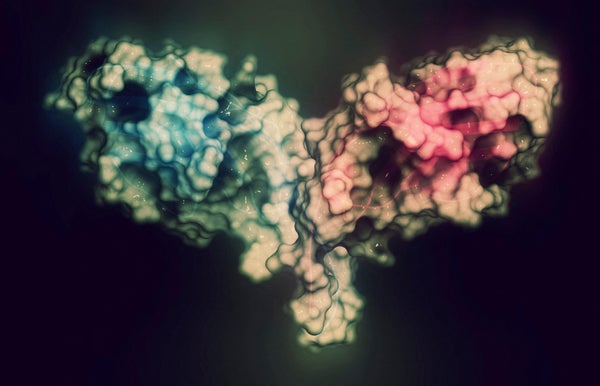
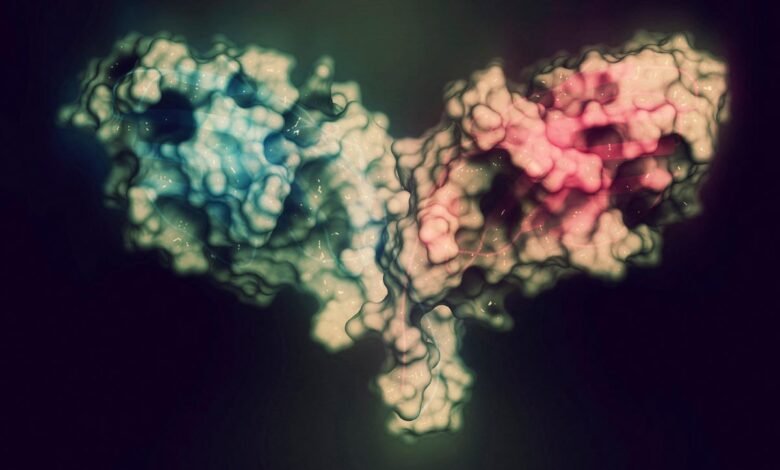
The AI tool designed binders against Cytotoxic T-lymphocyte-associated protein 4 (CTLA-4).
Science Photo Library/Alamy
The known protein universe just got a lot bigger. A newly released artificial-intelligence tool has generated an atlas of more than one billion predicted protein structures and billions more protein sequences.
The database, known as the ESM Atlas, was unveiled today by researchers at the Chan Zuckerberg Initiative’s Biohub, a biomedical institute created in San Francisco, California, by Facebook founder Mark Zuckerberg and his wife, physician and educator Priscilla Chan.
The atlas eclipses the AlphaFold Database of predicted protein structures by more than 800 million entries, and a previous ESM Atlas by some 300 million.
On supporting science journalism
If you’re enjoying this article, consider supporting our award-winning journalism by subscribing. By purchasing a subscription you are helping to ensure the future of impactful stories about the discoveries and ideas shaping our world today.
The predictions were made using ESMFold2, an AI model that Biohub says surpasses the performance of AlphaFold3, the latest version of Google DeepMind’s system and other protein-structure prediction AIs. The atlas is described in a preprint released today.
“What this atlas does is it shows the totality of protein biology and especially the parts that are most unknown,” says Biohub science head Alex Rives, who led the effort. “We think it’s going to be a really powerful substrate for the discovery of new biology.”
Other scientists are impressed with the results, especially that ESMFold2 is fully open source. But the Biohub model enters an increasingly crowded field, in which competing open-source and proprietary protein models are making gains at breakneck speed.
Antibody predictions
ESMFold2 is based on a ‘protein language’ model that Rives’s team unveiled in 2024, which was trained on billions of proteins from across the tree of life. It includes ‘metagenomic’ sequences from soil, ocean and other environments, which are absent from the AlphaFold database of predicted protein structures.
Rives’ team say ESMFold2 outperforms existing methods, including AlphaFold3, at determining the correct structure of complexes of interacting proteins – including antibody molecules binding to their antigen molecular targets.
In the preprint, the researchers describe how they used ESMFold2 to design new antibodies and other proteins that can strongly attach to proteins implicated in cancers and immunological conditions. When created and tested in the lab, a high proportion of the designs worked as predicted.
Rives’s team used the tool to create an atlas containing 1.1 billion predicted protein structures as well as information on the sequences of 6.8 billion proteins. Most of these come metagenomic sequences that had been only poorly characterized. Rives hopes that the atlas — which will be freely accessible — will help scientists to make connections between the known and unknown parts of the protein universe. Using the atlas, the researchers found structural similarities between CRISPR microbial defence proteins and a gene-editing protein identified in a soil fungus in 2023 and found in other eukaryotic species.
Supplementary database
The newly released atlas should be “an extraordinary resource for biology,” says Gemma Atkinson, a computational biologist at Lund University in Sweden. “It’s exciting to see how large scale protein language models can capture fundamental rules of protein biology.”
Christine Orengo, a computational biologist at University College London, says the predictions, which will first need evaluating, could help uncover new protein folds and functions, with implications for protein design and basic understanding of biology.
Martin Steinegger, a computational biologist at Seoul National University, says his biggest question is how well ESMFold2 can predict the structure of proteins that are very difference from those already known. His team found that the first edition of ESMFold wasn’t especially good at predicting unusual protein structures, especially those found in metagenome data.
Computational biologist Sergey Ovchinnikov at the Massachusetts Institute of Technology in Cambridge sees the ESM Atlas as a supplement to the widely used AlphaFold database of more than 200 million protein structures, rather than as a replacement.
ESMFold2’s predictions of interacting proteins are impressive, Ovchinnikov adds, but not all that surprising. Earlier this year, the Google DeepMind biopharma spin-off Isomorphic Labs unveiled a proprietary model that made substantial gains at predicting such structures. Open-source models that the Biohub team didn’t compare ESMFold2 against directly have also achieved impressive results at predicting protein interactions, Ovchinnikov says.
The fully open-source nature of ESMFold2, with no restrictions on commercial use, means that it could find wide use, says Ovchinnikov. “I expect many people will be excited to try ESMFold2.”
This article is reproduced with permission and was first published on May 27, 2026.
It’s Time to Stand Up for Science
If you enjoyed this article, I’d like to ask for your support. Scientific American has served as an advocate for science and industry for 180 years, and right now may be the most critical moment in that two-century history.
I’ve been a Scientific American subscriber since I was 12 years old, and it helped shape the way I look at the world. SciAm always educates and delights me, and inspires a sense of awe for our vast, beautiful universe. I hope it does that for you, too.
If you subscribe to Scientific American, you help ensure that our coverage is centered on meaningful research and discovery; that we have the resources to report on the decisions that threaten labs across the U.S.; and that we support both budding and working scientists at a time when the value of science itself too often goes unrecognized.
In return, you get essential news, captivating podcasts, brilliant infographics, can’t-miss newsletters, must-watch videos, challenging games, and the science world’s best writing and reporting. You can even gift someone a subscription.
There has never been a more important time for us to stand up and show why science matters. I hope you’ll support us in that mission.