Stephon Alexander 00:08
He was the one that really impressed somebody, the importance of intuition.
He said intuition is the lifeblood of a good physicist, of a great physicist.
David Payne 00:18
This is Creativity in Science, a series brought to you by Nature Careers.
Stephon Alexander 00:24
I would not be the physicist I am today if weren’t for my practice as a musician, especially as an improvisational musician.
Working on my improvisation, just actually improvising as a musician, somehow makes me more fluid and flexible mentally in terms of approaching and attacking physics problems.
David Payne 00:42
…a podcast about how science and creativity go hand in hand.
And about how one can nurture the other.
Stephon Alexander 00:52
…and it turned out to really work for me.
It really helped me become a more creative physicist, to think about ideas that I ordinarily would not have thought of.
David Payne 01:02
This time, a physicist who skillfully weaves his passion for jazz Improvisation with his understanding and teaching of complex ideas.
Stephon Alexander 01:20
Hi, I’m Stephon Alexander. I’m a theoretical physicist, and the director for the Brown University Center for Theoretical Physics and Innovation, in Providence, Rhode Island, a small, beautiful state with a lot of ocean.
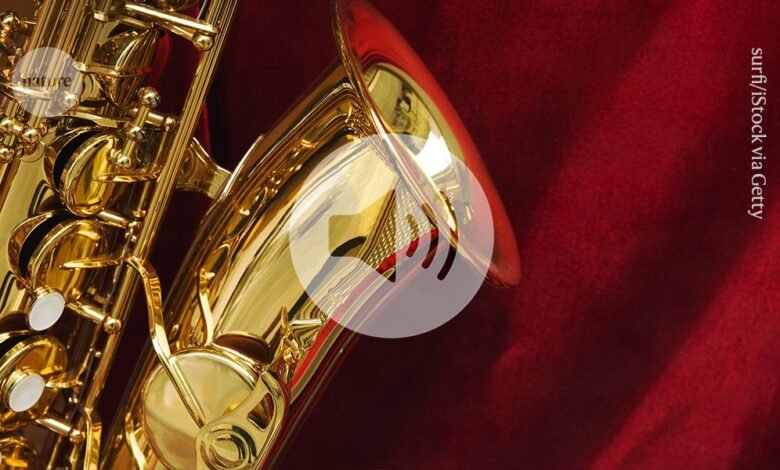
And I’m also a jazz saxophonist.
Yeah, how I got interested in music started way back when I was eight years old. My family immigrated to the Bronx, New York.
My grandmother, who had been in the country for about a decade prior, sent for us, and so it was always in her mind that I would become a concert pianist.
So she signed me up for classical piano lessons starting at eight. I did not enjoy practicing the piano, as I think most young people probably don’t, but I continued with that until I was 12 years old.
But then my father brought home a used saxophone from a garage sale.
He actually bought it from a former New York Yankees pitcher, I believe.
His wife, I think, bought it for him as a birthday present, but he never played it.
So my dad got it for a very cheap price. But the saxophone was really not introduced to me as something you have to practice, right?
So it started there, and then I had a little radio, one of these radios that would, you know, old school radios, where you turn a dial.
And I used to randomly, you know, surf radio channels back in the 80s.
This is in my little attic room in the Bronx.
And there was this saxophone playing that was completely out there, completely wild.
And it said, this is the music of Ornette Coleman. And this is free jazz. I was like, oh, this free jazz thing. What does this mean? You could just play whatever you want and make up whatever you want.
So my introduction to really getting into the practice of music and being an improvisation musician actually, this really started with Ornette Coleman, when I was probably like 13 years old.
Knew nothing about the guy, knew nothing about free jazz, but just the idea of a young person being able to pick up his horn and just play it without being judged was actually an important first step.
Stephon Alexander 03:27
In high school, I had another inspiration, Mr. Daniel Kaplan at my high school, at Duarte Clinton High School, which is a wonderful place.
I’ve been a high school student, although it was a wild place, all sorts of interesting people, six thousand students, all, a whole wide range of students, which is actually very important to experience.
And I was in an honors program within this high school.
So we took physics, and this physics teacher, Mr. Daniel Kaplan, was also a jazz musician. He was a professionally-trained jazz musician.
He went out to the Korean War and then worked on radar, so he kind of caught the physics bug when he came back.
He became also a physics teacher and a music teacher.
He was the one that really impressed on me the importance of intuition.
He said intuition is the lifeblood of a good physicist, of a great physicist.
And he would do a lot of exercises, and he would teach, to also to help us value the intuition, not just only solving equations (and those things are important) and developing skills, (those things were important), but also this idea of the intuition.
So that was an important development too, having this amazing teacher who had a wider appreciation for intelligence, that it could also include these forms of creativity in physics.
Stephon Alexander 04:57
How did my physics, and my doing in physics, and my knowledge of physics, influence how I play, how I approach music?
It’s really been a process over, like, the last, I don’t know, 35 years, maybe, where I started to experiment or allow those roles to speak to each other.
Sometimes, I look back, it was a bit of a shameful act.
Because, you know, those two worlds we’re talking about, we talk about, you know, music is about the human, human emotion. And it’s, maybe it’s about being entertained.
It’s about the party. It’s about these, it’s an art form. It’s all these other things.
But no, no, let’s not talk about…
It reminds me of one of times is in a jazz club I used to bring my my physics research papers and maybe sometimes sketch a little calculation while I’m listening to the jazz in this club in New York.
And I was friends with many of these musicians.
And after set, one guy, he was a pianist, I said, Yeah, your playing is really geometric. And there was this other guy, I’m not going to mention his name, he’s a very famous sax player. He goes, “I don’t know what you’re talking about, man.”
That just, it just sounds good.
Okay, so, so anyway, you could see why these, why it was a shameful act.
Stephen Alexander 06:11
But I would say that in physics we’re in search of beauty in our equations, and also maybe the economy, like the fact that F = ma, Newton’s law, is because one simple equation, force is equal to mass times acceleration, that equation can economically, in one shot, describe how an airplane lands in Chicago, to how an apple falls off a tree, to how a speed car turns around the corner, to how a planet goes around the sun, and how a comet flies around a galaxy.
So this one equation has an economy, an efficiency, and a logic.
And in a lot of ways, music for me, or some of my approach to my sax playing, is that you have infinite amount of these scales and chords, and I’ve always been in search of economic ways, like ways to summarize different patterns, different chord changes.
Can I economically find a hack, find a trick, just like a physics equation, to help me go through a jazz improvisation while the chords are changing?
So it’s things like that, where I take some of the logic or the patterns and the way we find patterns in physics and physics equations and concepts, and look for similar types of hidden patterns.
And as a strategy for improvisation.
Stephen Alexander 07:44
I would not be the physicist I am today if it weren’t for my practice as a musician, especially as an improvisational musician.
One thing that I found over the years is that I’ve played in, I’ve had the fortune to play in many different settings, so maybe in Latin jazz to a little bit of classical here, obviously free form jazz to very standard, what we call standard jazz, where you play through chord progressions and things like that. I’ve played, yes, I’ve had that fortune.
I am, as you know, I even have my own band with Melvin Gibbs and Will Calhoun and Jaron Lanier called God Particle. So we write our own music.
So there’s also creating and writing music.
And I find that one example, when you play in these different settings and you play with different types of musicians who may have different skillsets, they may be hearing the music differently, rhythmically things may be different.
You have to work with them.
You have to be able to coexist and play with them in service of the music.
At the end of the day it don’t matter if you’re on stage and somebody’s playing the loudest, whatever. If the overall effect of the music isn’t good, then you’ve all failed.
And similarly, I find that, like, as a physicist, it’s important to be able to, you know, be in dialogue with other physicists from different schools of thought.
So I was brought up as a quantum field theorist and a string theorist, and in terms of my formal training and relativity in the practice of being a theoretical cosmologist.
But I’ve learned that it’s also important to talk to skilled physicists with different perspectives, just like playing in a different musical genre.
And I find working at that interface and learning how to, how to be in dialogue with others, that people will say that, why talk to them? They don’t know physics.
They’re, you know, they work on this type of physics, and we work on the other kind of physics. I’m the exact opposite.
I say I need to talk to them because I need to learn something from them. Now, having said that, it’s also important. I call that like listening to your ear.
But if you don’t have a well-developed ear, well, you also need your technique. You need your skill. You need to know your skills. You need to practice your etudes so it doesn’t get you away from being solid and, well, you know, and well-skilled. It’s not an either or, it’s a both.
So if I am confident, you know, or I’m always working on my physics chops.
It gives me some, you know, I think, permission to go and talk to others in the pursuit of doing better physics.
So that’s one way I think, playing, you know, my musical practice has influence.
Stephon Alexander 10:43
The second one is improvisation. The art of improvisation is an endless thing, by the way. It’s never ending. That’s why I’m attracted to it.
Just when I think I’ve reached somewhere, it’s like, you know, there’s a, there’s an asymptote at infinity, right, of ways to develop in my improvisational skills.
And I find very simply, that working on my improvisation, just actually improvising as a musician, somehow makes me more fluid and flexible mentally in terms of approaching and attacking physics problems.
There are, other, I don’t. It’s not, it’s important that you don’t give up in a physics problem when you’re working on something. And part of not giving up is to maybe improvise and, you know, make a silly guess. And try it and see how that sounds, so to speak, metaphorically. See what path it takes you down.
And so that’s another place I find my music influence in my physics.
For me, the other thing that’s very important, and I think the way my music has really helped me as a physicist, is it’s one thing to say, oh, you know, it’s important to keep an open mind that, you know, as you’re approaching your research, or it’s important to be flexible in your thinking, or it’s important to embrace and maybe try to be outside the box.
But to actually be there, I think it’s important for me. Those are all ideals. For me, it’s actually hard to practice that.
And for me, where my music has really helped me is that I’m still a student. I actually have a teacher.
I actually have someone that, you know, I meet every two weeks.
I’m in front of him with my saxophone and I’m, and he’s making me feel like a baby that I, you know, like, like you need to, you need to work on that low B flat. No, you need to, you know, you put on the metronome, on 105, and do this.
And I think being in that state, where you, where you, I’m made to feel like this baby that doesn’t know anything, is a very healthy state of being humble.
And taking that humility into my research, into my physics, has been very, also very important. Being in that place of being a student has been very important as well.
Stephon Alexander 13:21
Part of, like, the way I interact with my group of students and postdocs is that we engage in something that looks like group improvisation.
Somebody may throw an idea out there, and then it’s our job to solo around that and support, you know, in a jazz situation, you have, like, the, you know, you have the band, the rhythm section, and someone comes up with a trumpet, and they do a solo.
It’s the rhythm section’s responsibility to hold that framework right, hold that, the rhythm, but also improvise along and sustain that solo. And support the soloist.
Similarly, if someone throws an idea out, the group has to, instead of saying, that’s wrong, let’s move on something else, they kind of play with it, very similar to improvisational acting, I’ve heard.
It’s a yes, and. Someone says something that the way you work with that is to move along with it.
Stephon Alexander 14:28
When given the opportunity to teach intro physics class, I usually begin with waves first, the physics of waves first.
And that’s also the mother tongue of music, because music is a physical expression, expression of sound waves.
And, you know, the way in which these sound waves come together to make higher order structure, (structure, ie, music), is, you know, something, lots of analogies there.
When we talk about in science, the role of structure and function, we can talk about how waves are structured together to create function in physical phenomenon such as resonance and refraction and all these other amazing things that waves do.
So that’s kind of one way, way into making these connections a little bit more concrete and these analogies more concrete.
I find it’s also, it doesn’t take away you, you, it doesn’t mean that you only talk about music, right?
Music is one of these things, or this language, or this analogy, is something that could just be additive on top, on top of the traditional ways that we teach or engage in physics.
And I think that what that does, it makes things a little bit more refreshing and inspirational to some people.
Stephon Alexander 15:53
The Brown Center for Theoretical Physics and innovation was founded based on the legacy of our teacher mentor, Leon Cooper, who won a Nobel Prize.
And then quickly from there, went into neuroscience research and machine learning AI research.
He was also a big music lover.
So he was a real example of a very creative and skilled physicist that spoke to others.
He said, “Why do I want to talk to people that knows exactly what I know?”
So he would always be engaged in interactions with others.
So our center is really taking that seriously.
And so we are an interdisciplinary theoretical sciences institute where we bring in colleagues from different, from different fields. And a lot from neuroscience, engineering, applied mathematics, computer science, as well as theoretical physics, AI, quantum computing, things like that, quantum information theory.
We’re very into this, and I think to do it properly. I think it’s really important to have creatives. When I say creatives, I mean like artists and elements of the art involved in our center as well.
So we do have, like, sort of what I call science-adjacent musicians and artists involved in our center.
We’re now talking to a choreographer who’s interested in some of the patterns found in physics and making dance out of that, we have Nona, the great Nona Hendryx.
She’s actually on our scientific advisory board. She’s a very, you know, she’s worked with George Clinton and Labelle.
So, you know, we find these ways of in very meaningful ways that advances our science, ways of connecting with the arts and so, yeah, stay tuned for that.
Stephon Alexander 17:48
I look back at my career, and I see a lot of, you know, a lot of coincidences and I see a young person that was trying to, trying to make it work for myself.
And there was uncertainty whether or not I would make it. It’s not clear that I made it, but I’m still in the game.
But the point is that I think one piece of advice I will give to young people is to really find a way to keep the passion alive.
There’s a lot of rote things that you have to do.
You have to play in the sandbox with others.
But find that part of yourself where you’re being, I hate to use that word, it’s a cliche, but being true to yourself.
Stephon Alexander 18:34
In my case, it turned out to be that as a musician, and having that passion for music, but also having that passion for my physics, finding a way for them to really support each other was important.
And I did. I did manage to find little ways to do that, and it turned out to really work for me.
It really helped me become a more creative physicist, to think about ideas that I ordinarily would not think of, to have the courage to do that, because in jazz improvisation, you have no choice but to have the courage.
Because if you play that wrong note in the middle of the solo, you have to make it right a split second later.
And being, just being agile, being flexible, knowing how to pivot, knowing when to, when not to give up on an idea and when to give up on an idea and pivot is also important.
And knowing how, that it’s important to embrace, to engage in conversations with others and not be afraid of that, and find ways of working with that.
And seeing that as a benefit to what could be and what could be a, maybe a, hopefully a breakthrough idea for you.