LIRR STRIKE: Talks break down, and 300,000 commuters now stranded as railroad employees hit picket line

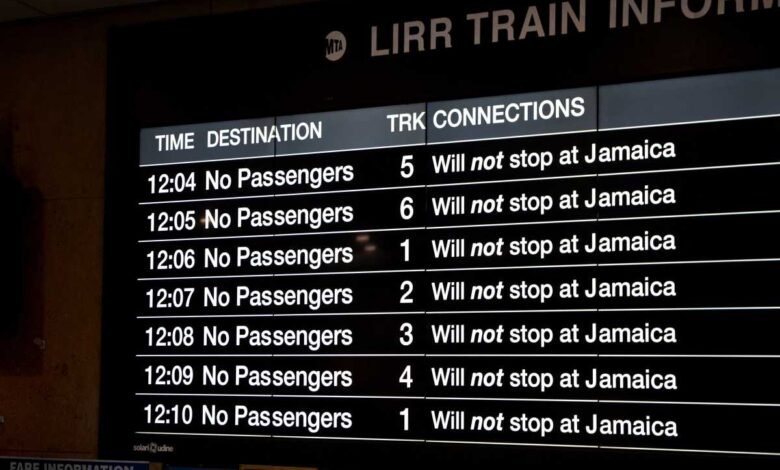
The Long Island Rail Road is out of service Saturday morning after workers from five different labor unions went on strike, as promised, after contract negotiations with the MTA broke down.
Some 300,000 daily commuters who rely on the LIRR in New York City, Nassau and Suffolk Counties now need to find an alternate way to get around, or scrap plans for long travel throughout the region. Officials have said the MTA’s announced contingency plans — including shuttle buses to replace train service — would not be enough to alleviate expected traffic.
All LIRR service is suspended systemwide, the MTA reported, while advising those who use the railroad to get to and from work to shift to remote working if possible.
How long the strike and service suspension will last is unknown, but both sides were quick to point fingers for the breakdown in talks that led to the walkout that took effect just after midnight on May 16.
The five unions that walked off the job — Brotherhood of Locomotive Engineers and Trainmen (BLET), the Brotherhood of Railroad Signalmen (BRS), the International Association of Machinists and Aerospace Workers (IAMAW), the International Brotherhood of Electrical Workers (IBEW), and the Transportation Communications Union (TCU) — said the MTA “refused to agree to a contract that wasn’t concessionary” in rebuffing the recommendations of two federal panels to increase LIRR worker salaries between 4.5 and 5%.
“MTA and Gov. [Kathy] Hochul determined that they would rather create frustration and gridlock for thousands of commuters, spend millions on buses during a strike and lose millions in lost revenue rather than settle a contract meant to keep pace with the rising cost of living,” said Nick Peluso, serves as the National Vice President of the Transportation Communications Union.

MTA Chair and CEO Janno Lieber conceded that a strike was a lose-lose situation for everyone involved — the MTA, striking workers and commuters alike — but charged that the unions failed to negotiate with the authority in good faith.
“At the table this week – and especially today – we upped our proposals again and again, even as the other side reciprocated little or nothing,” Lieber said early Saturday. “Our last offer literally gave them everything they said they wanted in terms of pay but they rejected even that. Then we offered to conclude a contract just on the three years where we agreed and to go into binding arbitration on the fourth. Still, it was rejected. For me, it’s become apparent that these unions always intended to strike. Their strategy is to inconvenience Long Islanders and try to force the MTA and the state to do a bad deal.”
Hochul echoed Lieber’s beliefs that the unions had acted without good faith, but also pointed a finger of blame at the White House for contributing to a hostile environment.
“The disruption that Long Islanders face starting tonight is the direct result of reckless actions by the Trump Administration to cut mediation short and push these negotiations toward a strike,” Hochul said early Saturday. “For weeks, the MTA has attempted to negotiate in good faith and put multiple fair offers on the table that included meaningful wage increases, but you cannot make a deal if one side refuses to engage in good faith.”
The five unions on strike collectively represent 3,500 LIRR workers, including engineers, electricians, signal inspectors, machinists and ticket agents, who account for over half of the railroad’s workforce.
What’s the alternative without LIRR service?

It’s the first time in 30 years that LIRR workers have walked off the job, and brought the nation’s largest commuter rail system to a standstill. The options for commuters without cars traveling between Long Island and New York City are few and far between.
In fact, the MTA is encouraging any Long Islanders who can to work from home during the strike rather than attempt to commute.
For those who need to go into the city, it will offer limited shuttle buses during the morning peak, from 4;30 to 9 a.m., toward the city, and the afternoon peak, between 3 and 7 p.m., back toward Long Island. However, officials have warned that the buses will hardly be a full substitute for regular rail service.
The shuttles will run every 10 minutes, departing from and returning to LIRR stations across Nassau and Suffolk Counties. Those include Huntington, Ronkonkoma, Bay Shore, Hempstead Lake State Park, Hicksville, and Mineola.
Buses departing from the first two stations will offload and pick up riders from the Jamaica-179th St F train station in Queens. Those coming from the other four stations will conduct drop-offs and pick-ups from Queens’ Howard Beach-JFK Airport A train station.
Shuttle buses from Bay Shore, Huntington, and Ronkonkoma will also offer reverse peak service, according to the MTA website.
The MTA is also encouraging Nassau County riders to take the Nassau Inter-County Express (NICE) to and from subway stations in eastern Queens.
Cautious optimism gives way to disaster
The strike went on after hours of talks between negotiators for the unions and the MTA on Thursday and Friday bore plenty of cautious optimism, but no deal.
As the deadline approached, Gary Dellaverson, the MTA’s outside labor counsel and chief negotiator, had been “confident” that a resolution was in sight before the strike deadline of 12:01 a.m. on May 16.
“I’m always optimistic that this process that I’ve been engaged in for basically my entire adult life can result in a successful resolution,” Dellaverson said on May 14. “I believe that as long as you come in in good faith and you work hard towards a resolution, you can find a common ground, you can find an agreement. So I remain confident and optimistic that that will be true. But again, as everybody knows, dancing takes two partners.”
Dellaverson said that Lieber joined the May 14 talks, which he said helped with “setting the tone of how important this is” to the agency.
Meanwhile, Kevin Sexton, vice president of the Brotherhood of Locomotive Engineers & Trainmen (BLET), one of the five unions negotiating with the MTA, claimed in a statement that the transit agency has “finally started negotiating real wages.”
But they continued to slam the MTA’s offer of a lump-sum, rather than recurring, raise for 2026 that would make the amount it is offering for this year equivalent to a 4.5% raise as a “gimmick.”
In the end, the scramble to keep the LIRR workers on the job and the system running failed. Hochul urged the MTA and unions to keep talking with each other until a deal is done, but one union leader offered no timetable on when the job action would end.
“This is an open-ended strike. We don’t know when it will end. It shouldn’t have begun. Management through their provocations and game-playing own this one,” said Gilman Lang, who serves as general chairman of the Brotherhood of Locomotive Engineers and Trainmen.
As the MTA grapples with the LIRR strike, it also needs to contend with the TWU Local 100, the union representing nearly 40,000 New York City Transit employees who keep the subways and buses running.
The MTA and Local 100 held a two-hour bargaining session early Friday to negotiate a new contract; the current collective bargaining agreement expires on Saturday. The union has yet to announce any potential job actions.