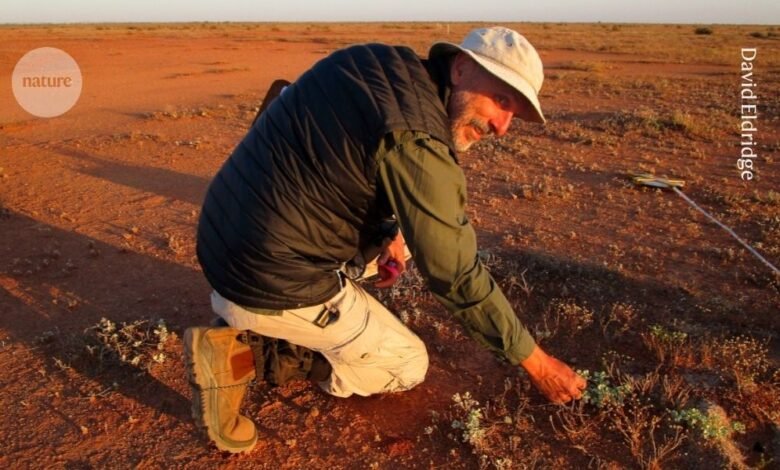

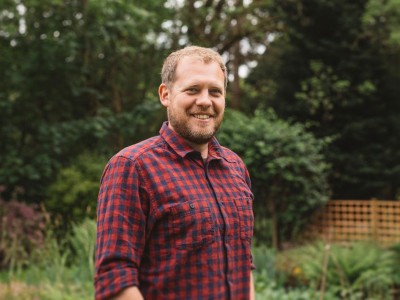
Frank Hemmings collects, catalogues and preserves plant specimens for research.Credit: David Eldridge
In the scorching heat and across the rugged landscapes of southeastern Australia, Frank Hemmings has conducted vegetation surveys for more than 27 years. He has collected and documented thousands of plants from grasslands, forests and some of the nation’s driest regions. As a curator at the John T. Waterhouse Herbarium at the University of New South Wales in Sydney, he carefully dries, identifies and catalogues every specimen, adding each one to a vast archive of plants lining the shelves. His work, which began with roadside field trips to collect weeds, eventually produced specimens that would become indispensable to researchers globally, across a wide range of scientific fields. “I didn’t realize early on how managing a collection of biological specimens means that the samples I collect or identify could lead to work for someone else years down the track,” Hemmings says.
As a scientist in a research-support role, he doesn’t independently write academic papers or conduct experiments. Instead, Hemmings meticulously gathers and preserves the samples that other scientists use to collect data and make discoveries. “I’m not obligated to produce research from these data,” he explains. “My responsibility is to make them available so others can use them in their research.”
Research is powered by technical talent — and recognition is finally on the rise
Hemmings has collected 3,782 specimens and helped to identify more than 10,500. The leaves that he has pressed have contributed to studies in fields such as pharmaceutical chemistry, phylogenomics, ecology and climate change. “Even though I’m listed as a co-author on 27 papers,” he says, “it blew me away to learn that at least 93 other studies were built on the thousands of specimens I collected and identified.” He says that sharing specimen data and metadata is the core of his mission. He vividly recalls a tense discussion with a representative of his university’s legal department, who wanted to impose strict restrictions on distributing collected specimen data. He responded with resolve: “You have to understand — this goes against the very essence of science.”
Hemmings is part of a vast number of research-support specialists working at scientific institutions around the world, often in the shadows. As the ‘stagehands’ of science, they are mostly invisible to the audience but essential to the show. Even though their fingerprints are all over many data sets, they’re rarely recognized as full contributors on projects, as co-authors and in other ways that are formally rewarded by the scientific establishment. In publications, they often appear only in a short phrase in the acknowledgements section. Their hidden labour and expertise can be difficult to measure.
Simon Hettrick, the chair of the Hidden REF initiative, a campaign launched at the University of Southampton, UK, in 2020 to highlight and celebrate these crucial roles, says that “this lack of recognition translates into significant difficulties for people in these roles: in getting support, finding positions and progressing their careers”.
Nature’s careers team interviewed research-support professionals to hear how their work helps to shape the course of modern science, and how recognition — or the lack of it — has influenced their careers.
Hidden hands
“I knew from the outset that I wasn’t born to be that kind of scientist who lives between papers and peer reviews,” says Marten Schöle, a fossil preparator at the Berlin Natural History Museum. As a teenager, he was drawn to the craft of fossil preparation. Schöle made an early, deliberate choice to step away from academic research, which he found overly narrow because scientists often spend years focused on a single question or fossil. At the Walter-Gropius-Berufskolleg, a vocational college in Bochum, Germany, he trained for three years to become a fossil technician. “What keeps me going in this career is the freedom to explore an extraordinary range of fossils and time periods — from a tiny Cambrian worm that lived half a billion years ago to hominin remains a few thousand years old.” That diversity, Schöle says, brings constant excitement and a renewed sense of discovery.
Schöle’s work extends beyond the museum walls. Travelling with field teams, he uncovers and preserves fossils so that they can be transported to Berlin: crocodile-like remains unearthed in Sudan’s deserts, ancient whales and manatees in Iran and amphibians from the Permian period in Russia. Back in the laboratory, he reconstructs and restores the fossils and creates precise 3D models for research. His work demands absolute focus — a single blunder can destroy fossils that nature has preserved for thousands of millennia. He recalls when the skull of an extinct cave bear (Ursus spelaeus) once slipped from his desk and shattered on the floor. “I felt my heart stop,” he says. For four months, he painstakingly glued every fragment back together, often late into the night.

Fossil preparator Marten Schöle (left) contributes crucial support to palaeontology research.Credit: Faysal Bibi
Tech support
Philippa Broadbent also embraces working in a supporting role, but she is a member of an emerging generation of research-support specialists who are fluent in coding, software and data. “Research software engineering is still taking shape,” says Broadbent, a software engineer at the University of Southampton. She describes herself and others in similar roles as the people who improve the accuracy, reproducibility and scalability of research by building sustainable, well-engineered software and teaching researchers how to use and develop essential programs. “The term only appeared about 14 years ago, and it’s up to us to define the future of this field.”
While doing a PhD in psychology, Broadbent joined a journal club analysing reproducibility by looking at scientific literature. “That’s when I realized how central software is to making research transparent and reproducible,” she recalls. That insight ultimately led to her current career. She works on research projects across diverse, often unrelated scientific fields, which demands the continuous adaptation of her tools to meet each researcher’s needs. “The most daunting part,” she explains, “is diving into a completely new area and learning fast enough to support the research effectively”.
Time to celebrate science’s ‘hidden’ contributors
Harry Biddle provides support for research at the Stockholm Environment Institute (SEI) as a data engineer. “I’ve always loved being around researchers in that environment of discovery, but I always hesitated to become a researcher myself,” he says. After earning a master’s degree in mathematical modelling and scientific computing at the University of Oxford, UK, he considered doing a PhD but was drawn more to software programming and design than to academia. Between 2011 and 2015, Biddle worked on software tools for fluid and ocean simulations that were used in famous films, including Interstellar, Les Misérables and films in the Batman and Marvel franchises.
Now, he makes the tools behind the SEI’s Trase project, which tracks the international trade in commodities, such as palm oil, that contribute to tropical deforestation. “I build all the infrastructure that researchers rely on for their research,” including platforms to store and transform data and software tools to build supply-chain models, he says.
Assisting the animal world
Research support can even be life-saving. “Many researchers don’t realize what goes on behind the scenes for us to deliver the results we do,” says Sharon Price, a baboon colony manager at the Southwest National Primate Research Center in San Antonio, Texas. She continuously monitors the colony and aligns its care with ongoing research needs. The animals that she looks after have an important role. “They are our first line of defence in understanding and managing human diseases,” because scientists can observe how pathogens behave in primates.

Sharon Price cares for a baboon colony.Credit: Texas Biomedical Research Institute
Not all support specialists come from an academic background. Fiona Lynch worked in underwater construction for nearly two decades before she became a remotely operated vehicle (ROV) specialist at the Ocean Tracking Network at Dalhousie University in Halifax, Canada, in 2022. “I always wanted to contribute to marine science,” she says. “I realized I could combine my technical skills with something meaningful.” The hands-on skills she developed from surveying pipelines and working with underwater tools and equipment helped her to pilot and maintain a fleet of ROVs used to study deep-ocean ecosystems. Lynch has operated ROVs capable of descending to 1,000 metres, but piloting them was never simple. Shifting weather, strong currents and the occasional equipment failure tested both her skill and her nerve. “In such circumstances, getting the ROV back is a real tug of war,” she admits. “If these vehicles don’t return, the scientists can’t access their data.”
Unseen and uncredited
Because they work behind the scenes, and their efforts are rarely visible beyond their immediate teams, research-support personnel can seem detached or isolated from the broader research community. Everyone on a film set is mentioned in the credits, but the same cannot be said for people such as Schöle. He often hears the stereotype that fossil preparators are grumpy or withdrawn. But he explains that long hours bent over a microscope, using a fine needle on fragile specimens, demand intense concentration and mental endurance. “It’s simply mental exhaustion,” he says. “We just need some solitude to rest and recharge.”
Broadbent notes that there is a similar misconception in her field: “People assume research software engineers work alone, isolated from everyone,” she says. “In reality, it’s a highly collaborative job — we constantly interact with researchers and others across the research community.”
Despite close collaboration with academics, many of these specialists struggle with their professional identity. Even those who have completed postgraduate degrees often question how they fit into the conventional hierarchy of scientific positions. Many feel that if they are contributing to research, then their names should appear on the papers that use their work. If their accomplishments carry the pulse of discovery, then they shouldn’t be treated as merely equipment operators, support specialists say. This lack of acknowledgment has consequences; it can foster resentment between researchers and support personnel, lower morale and stifle collaboration. And of course, it could make career advancement for people in support roles more difficult.
Why science needs more research software engineers
Research-support professionals say that it’s time to start bridging the divide. “There may be academics who view research software engineers as less important, or see their work as a lesser career compared with the traditional academic path,” Broadbent says. Changing that perception, she adds, requires advocacy. “We still have to convince decision makers at the top of scientific institutions that our work is critical.” Schöle knows the feeling well: “You’re often seen as low in the pecking order and not always allowed to speak up when something isn’t right,” he says. Although his relationships with researchers are mostly positive, many younger scientists, he notes, don’t fully understand or value the preparator’s contribution.