Jimmy’s Corner attorney spars with judge in court appearance to save the bar from eviction

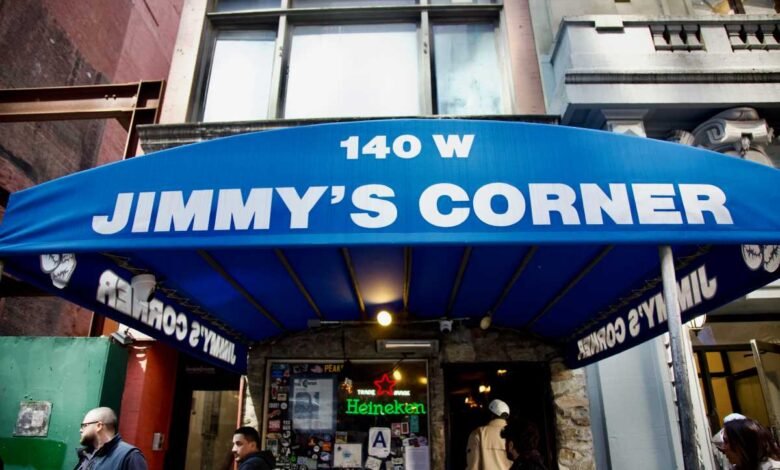

A Manhattan supreme court judge questioned on Wednesday if the legal fight to save Times Square dive Jimmy’s Corner might end in a knockout for the beloved bar.
A lawyer for the West 44th Street watering hole came out swinging at a hearing for a motion to dismiss its lawsuit against Royal Realty Corp, an affiliate of the Durst Organization, alleging that the company employed deceptive and discriminatory tactics in its attempt to cancel the commercial lease for Jimmy’s Corner.
In late 2023 the Durst Organization decided to sell the building and attempted to cancel the bar’s lease through a “death clause” provision that was triggered by the passing of its founder James Glenn. James’ son and the bar’s current owner, Adam Glenn filed the lawsuit last year to stop the termination of the lease until its end in 2029.
At the hearing on Wednesday, Manhattan Supreme Court Justice Nancy Bannon took aim at plaintiffs’ assertion that the death-clause provision for Jimmy’s Corner was born from racial animus on the part of the Durst Organization.
Counsel for Jimmy’s Corner has argued that the landlord’s invocation of the death clause was tied to racial animus against James Glenn, who was Black, and other Black patrons who would come there because of its welcoming reputation. Swetnick said in the hearing that Durst does not have a death clause in any of its other leases, which he finds to be evidence of racial bias.
“What was the basis of discrimination — race? And I assume that that person had the same race when he signed the first lease?” Bannon said.
Swetnick shot back that it was not only Glenn’s race that was the basis for discrimination but that the invocation of the death clause in 2023 was tied to the Black patrons of the bar, whom the suit alleges the landlord had complained about.
The landlord argues that the discrimination claims around the death clause, which was first signed in 2010, are barred by a statute of limitations.
“They’re out of the box on statute of limitations. There’s no argument that they have come up with that can abrogate the statute of limitations,” said Deborah Riegel of Rosenberg & Estis.
The bar has argued that their claims are not premised on the 2010 insertion of the death clause in the lease, but a continuing pattern of discriminatory conduct that culminated in the 2025 termination notice. Riegel called the bar’s argument a “kitchen sink approach” that jumbles time periods together “in the hopes that something survives.”
In his argument, Swetnick referenced a well-known piece of lore about the founding of Jimmy’s Corner, which is that the elder Glenn saved Seymour Durst from being robbed and the two became friends, setting a trusting relationship between the bar owner and his landlord.
“That’s a nice thing if it was done but what does it have to do with this case?” Bannon said.
Bannon reserved judgment on the motion at the hearing. The judge said a previous order prohibiting the bar’s eviction remains in effect while she considers her ruling on the dismissal motion.