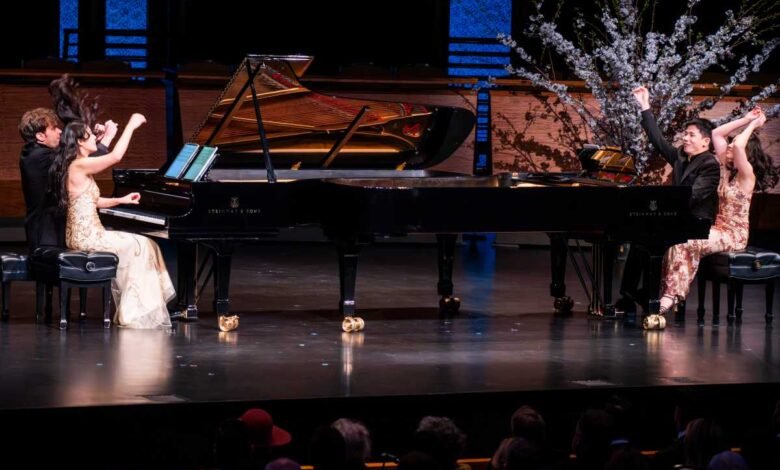

Young Concert Artists annual gala and performance at Jazz at Lincoln Center, 4/7/2026. Photo by Chris Lee
Music, at its highest register, is not entertainment. It is inheritance. It is the preservation of human feeling across centuries, carried forward by those willing to devote their lives to something invisible yet undeniable. In a moment where attention is fragmented and depth is often sacrificed for speed, institutions that protect and elevate that lineage feel, perhaps more than ever, essential. Young Concert Artists has, for 65 years, done precisely that, and its anniversary gala at Jazz at Lincoln Center revealed something equally vital: not only the power of music, but the careful, deliberate fostering of talent that ensures its future.
The room held a rare electricity, though not the kind that demands attention. It gathered, quietly, through presence and purpose. Students and alumni moved through the space together, not as separate generations, but as a continuum. There was a sense, almost understated, that what was unfolding was not simply performance, but lineage in motion. Columbus Circle shimmered just beyond the glass, the city in constant flux, while inside, something more enduring took shape.
Kevin Joyce carried the evening with a warmth that felt instinctive rather than performative, keeping the room both engaged and at ease. That tone extended naturally into the auction, where generosity translated into tangible support, reinforcing the very structure that allows young artists to emerge, develop, and ultimately take their place within the canon. Leadership anchored the evening with quiet clarity. Daniel Kellogg and Paul J. Sekhri articulated a vision grounded in both stewardship and forward motion, while Susan Wadsworth remained a presence that could be felt as much as named. Her legacy lived not in abstraction, but in the very musicians taking the stage.
The performances began with something both unexpected and quietly exhilarating: a quadruple piano interpretation of Bedřich Smetana, performed by Chaeyoung Park, Ying Li, Albert Cano Smit, and Zhu Wang. There was, at first, a sense of curiosity—four pianists sharing a single musical language—though what followed felt closer to a conversation unfolding in real time. At moments, it approached something resembling a duel, though never competitive in the traditional sense. It was responsive, fluid, alive with interplay, revealing both individuality and cohesion. The effect was quietly thrilling, a reminder that virtuosity, when placed in dialogue, becomes something far more expansive.
The program moved with intention from there. Johannes Brahms introduced a density that required attention, his compositions balancing structural rigor with emotional restraint. Wolfgang Amadeus Mozart followed with a clarity that felt almost architectural, each phrase placed with precision that masked its underlying complexity.
Then came the emotional center of the evening.
Carter Brey and Anne-Marie McDermott took the stage for the Cello Sonata in G minor, Op. 19 by Sergei Rachmaninoff, a work composed at a moment of personal recovery, where fragility and strength coexist in delicate balance. Their performance carried a depth that felt almost immersive. Brey’s tone drew the room inward, while McDermott’s playing moved with a clarity and command that felt, at times, beyond language. There was no separation between performer and instrument. There was only expression. McDermott, quite simply, stands among the finest pianists to approach the instrument, and witnessing her in this context felt less like observation and more like proximity to something rare.
The evening concluded with Serenade for Strings in C Major, Op. 48 by Pyotr Ilyich Tchaikovsky, a work that carries both homage and emotional intensity in equal measure. The energy in the room shifted, expanded, became almost difficult to contain. There were moments where applause threatened to break through before the final notes resolved, not from impatience, but from an excess of feeling. The music did not simply land. It moved through the room, leaving something altered in its wake.
Dinner followed, elegant and considered, though it felt almost secondary to what had already been experienced. Conversations carried a different tone, softened, reflective, as though the evening had recalibrated something subtle but significant.
This is, perhaps, the true work of Young Concert Artists.
Not only to present excellence, but to cultivate it. To identify talent before it is fully formed, to support it with intention, and to create the conditions under which it can flourish. The presence of both students and alumni on that stage made that mission unmistakably clear. This was not simply performance. It was continuity.
The gala did not merely celebrate 65 years.
It quietly affirmed what must come next.
The city moved on outside, as it always does.
Inside, for a few hours, it listened, and perhaps, more importantly, it believed.