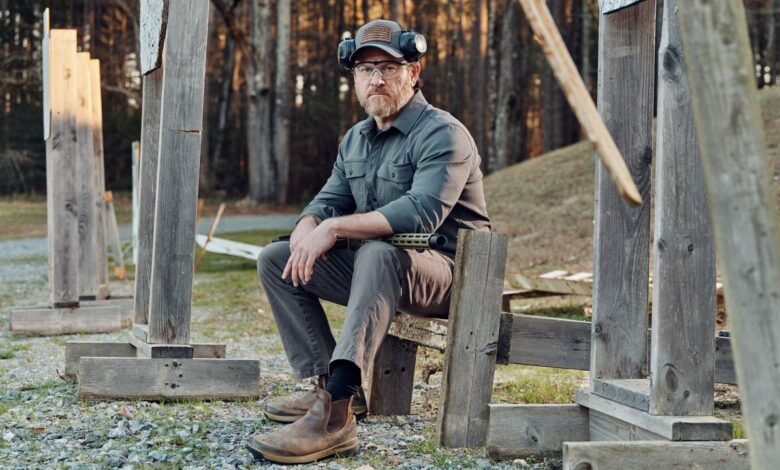
So I was surprised when, in early 2024, Chalker sent me an e-mail introducing himself. He had read an article I wrote for this magazine about an innocent American caught up in spy-vs.-spy battles among Persian Gulf monarchies, and he wanted to talk. We arranged to meet at his office, high in the World Trade Center. Now fifty-four, Chalker is nearly six feet tall and barrel-chested, with short brown hair and a thick, graying red beard. His suite in the World Trade Center is cavernous, with a view that sweeps from the Brooklyn Bridge to the Statue of Liberty. A collection of historic encryption machines is displayed in vitrines in the main room, and in his corner office he keeps half-empty bottles of obscure liquors from around the world. The whole place could have accommodated dozens of people. But, aside from a receptionist, he appeared to be alone.
Chalker told me that his consulting firm, Global Risk Advisors, had once employed nearly two hundred people, almost all of them former military and intelligence officers. Before Broidy’s lawsuit, the company had earned about a hundred million dollars a year. By 2018, he had also founded a second company, Qrypt, which develops cutting-edge quantum encryption, and had hired dozens of computer programmers. But Broidy’s suit received tremendous publicity, driving away all of Global Risk’s clients, even the Qataris, and Chalker was forced to lay off its entire staff. Qrypt had been negotiating its first large contract, with the Pentagon, until a counterintelligence official called about Broidy’s allegations. Chalker virtually shut down that company, too, although he kept its name on the empty suite in the World Trade Center. Since then, Chalker said, he had “not earned a single penny.” He lost a lectureship at Yale after the Yale Daily News wrote about Broidy’s lawsuit. Banks refused to do business with him. His insurance company had even cancelled his homeowner’s policy, because he was deemed too great a risk.
News reports, citing anonymous sources and Broidy’s suit, alleged that Chalker had hacked various other eminent figures, including the Emirati Ambassador to Washington; that he had spied on Switzerland’s top prosecutor and two Republican senators; and that he had deployed such spy tricks as covert surveillance and honey traps—sexual lures—in order to help Qatar secure the rights to host the soccer World Cup in 2022. Chalker, who denied all of these allegations, told me that the stress of Broidy’s lawsuit made him vomit so frequently that he eventually required esophagus surgery.

“Frankenstein’s Monster? From now on, it’s just Frankenstein. Welcome to America.”
Cartoon by Benjamin Schwartz
Recently, however, he and Broidy had settled the suit. Chalker told me that the terms were confidential but that he wanted to repair his reputation. He had always been an American patriot, he insisted, and to prove it he was willing to talk publicly, for the first time, about his years of clandestine work for the C.I.A.—which, he said, had “prevented Iran from getting a nuke.”
Chalker told me that, just as he had promised his wife, he had never personally engaged in combat or killing. Yet, during many conversations in the past two years, he also told me that he had risked his life for the agency, and that he indirectly carried responsibility for some killings. He acknowledged that luck—“right place, right time”—had played a big role in the success of his various covert operations. But he also insisted that he had helped obtain pivotal information that laid the groundwork for more than a decade of American efforts to disrupt the Iranian nuclear-weapons program, from the Stuxnet cyberattacks, which occurred around 2010, to the Obama Administration’s nuclear deal, in 2015, to the U.S. air strikes on Iranian atomic-energy facilities in the summer of 2025.