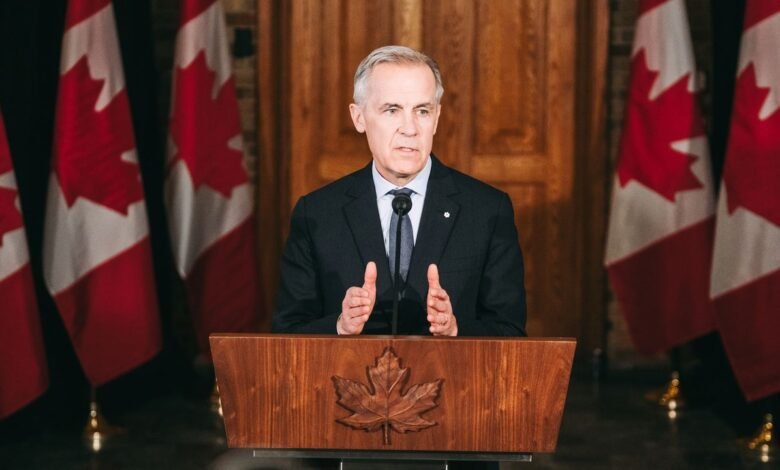
It may well have been a bargain worth making for countries such as Canada. But now, since the U.S. has decided to dispense with even the veneer of equality, and instead has committed itself to the principle that, as Stephen Miller, one of Trump’s top advisers, put it recently, we inhabit a world that “is governed by strength, that is governed by force, that is governed by power,” countries like Canada no longer get to make that bargain. They are told what to do, and tough if they don’t like it.
So, as Carney explained, those middle countries had best learn to stick together, and to stand up in something like coördinated fashion to the bully, since as individual nations they are simply too vulnerable. “You cannot ‘live within the lie’ of mutual benefit through integration when integration becomes the source of your subordination,” he said. Instead, nations will need to engage in “risk management,” strengthening themselves against attack and building new, more provisional, alliances. Carney, for instance, signed new trade pacts in recent weeks not just with South American nations but also with China, allowing limited imports of E.V.s in return for reduced tariffs on canola oil. On such things will the world now turn, but, if countries decide to go it alone, they will eventually lose. “In a world of great-power rivalry, the countries in between have a choice: compete with each other for favour or to combine to create a third path with impact,” Carney said.
And what made his vision something more than Thucydidean realism was his reminder that these “middle powers” by and large still represent the core of values that America is now abandoning, and that they can build their unions at least in part on those shared ideas. Canada, he pointed out, “is a pluralistic society that works. Our public square is loud, diverse, and free. Canadians remain committed to sustainability.” (That last point is no small thing on a rapidly heating planet.) He added that, together, these nations “can build something better, stronger, more just.”
One can fault Carney on how well he’s kept his own promises domestically. Last fall, one of his cabinet ministers, a former environment minister, resigned because the Prime Minister had cut a deal with the oil-patch province of Alberta to let it build new oil pipelines to the Pacific Coast for shipment to Asia. I find it hard to believe that Carney—who is, remember, an economist—really believes there will be a market for that crude. Just last week, Mitsubishi and Shell were reportedly looking into selling part of their stakes in big Canadian liquid-natural-gas projects, as the demand for solar power surges across Asia. My guess is that Carney may be trying to thwart Alberta’s separatist impulses—there is a campaign for a secession referendum later this year, one that Trump’s Treasury Secretary Scott Bessent has been doing his best to encourage.
But that’s internal politics. In the larger world, Canada is emerging as the most levelheaded player out there: far firmer than the United Kingdom, led by Keir Starmer, and less mercurial than France under Emmanuel Macron. Trump certainly realizes this. In his own Davos address, on Wednesday, in between mixing up Iceland and Greenland, he had a message for the Canadians: “I watched your Prime Minister yesterday. He wasn’t so grateful. They should be grateful to us, Canada. Canada lives because of the United States. Remember that, Mark, the next time you make your statements.”
What really bothers Trump, I think, is just the notion of a world order in which other countries decide to band together and to play by the rules, instead of letting themselves be picked apart by him. In Carney’s modest vision, there’s at least the hint of what could happen in the much hoped-for future where Trumpism ceases to be a major factor. There’s no guarantee, of course—a decade from now, a J. D. Vance or a Marco Rubio may still be throwing the nation’s diminishing weight around. But let’s at least pretend that, someday, reason will again prevail below the Forty-ninth Parallel.
If that blessed day arrives, there will be no way that America can simply step back into its commanding role in the international order. For one thing, we’ve immeasurably strengthened China; for another, no one is ever going to forget that we were an unstable nation that elected an obvious idiot to be its leader. Which, in a way, would actually be O.K. We obviously no longer deserve world leadership, and it might be a relief to become something of a dependable middle power ourselves. By size and wealth we’ll always be large, and there will always be a domestic political market for American glory, but it’s at least possible to imagine many Americans deciding that we’d like to be a reliable part of something that we don’t run. Perhaps we, too, will decide to become a middling power, full of sensible citizens that care about things like health care and education, not things like territorial expansion. Maybe we could just be an oversized Belgium, hemming ourselves in with the same rules that we’ve applied to others. (Most Americans, I think, might take this deal—polling, for instance, shows that only nine per cent favor seizing Greenland.) Modesty might actually seem attractive, after the nerve-jangling, always-on-tenterhooks Trump years. No one has to think about Mark Carney around the clock, worried that he’s going to do something ugly. We could be a southerly Canada, a de-facto eleventh province. Wouldn’t that be calm? ♦