I’m a rational person. I grew up in a family of scientists. My dad, who studied the brain, told me when I was a kid that Santa and God didn’t exist. (Don’t say anything at school, he suggested.) My uncle, a molecular biologist, delivered impromptu poolside lectures on the recombinatory power of DNA. But my mother, who’d been an English major, was superstitious. She was alert to the sinister possibilities of weird coincidences—two tails-up pennies found on the same day, three flat tires in a row on the left side of the car. One summer, a cardinal took to flying at the glass of our living-room window; she interpreted this as an omen. She was drawn to people with a similar orientation. Once, one of her boyfriends claimed that he was seeing the Devil. He’s right there, the boyfriend said, in the far corner of the room. Look—you can see his eyes.
Maybe it’s not surprising that, in middle and high school, my favorite writer was Stephen King. Later, I fell into the vortex of “Twin Peaks,” and of David Lynch more generally. The world is full of bad actors—cheats, liars, tyrants, sickos—who are, ultimately, mere human beings; at least, this was how rationality would have it. But King and Lynch were interested in evil, an abstract force. An outmoded concept, evil was baggage from a pre-modern age, the least useful way to interpret bad behavior. And yet it still exerted a pull, I thought, because every so often people do things so terrible that our rational, psychological vocabulary feels impoverished. Did I believe in evil? No. But I believed that people believed in it. And sometimes I could think of no other word for the insensible malevolence that seemed to steer people and events toward awful ends.
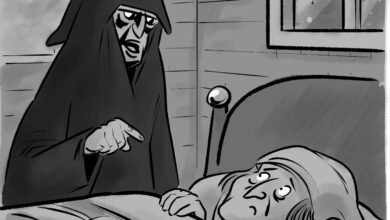
And yet my mom’s boyfriend didn’t say that he saw evil in the corner. He said that he saw the Devil. To matter to us, abstract forces have to become concrete. At that point, they risk becoming hackneyed, unimpressive, absurd, even silly. “What was hidden in the depths would often appear so flat when brought to the surface,” an artist named Tove thinks in Karl Ove Knausgaard’s novel “The Third Realm.” “The meaning would be squashed if the symbols were too familiar.” Tove wants to depict the intensity of having a body—a violent, irresistible reality that breaks down the boundaries between living things. But she can’t do it—in fact, she laments that her drawings look like New Yorker cartoons. This doesn’t mean that the intensity she recognizes doesn’t exist, only that she’s failing to properly understand or represent it. It could be that some of the forces that shape our lives will always resist being represented. They may be too big or strange to fit into our heads.
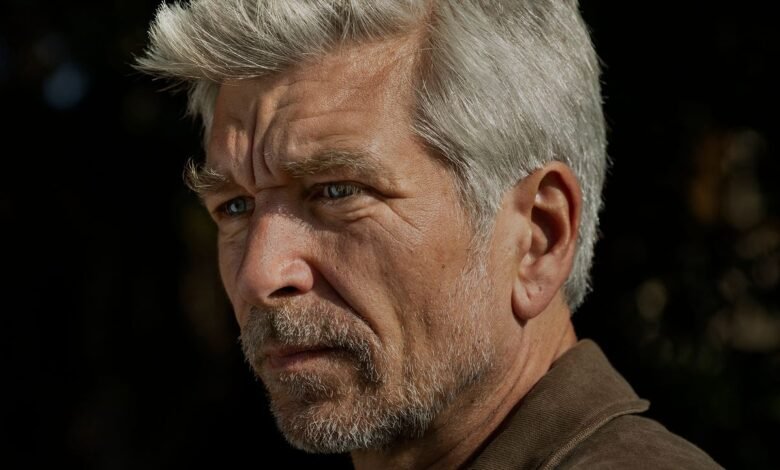
Knausgaard, a Norwegian novelist, rose to global prominence in the twenty-tens, with “My Struggle,” a six-volume autobiographical cycle. The books were all about his personal life—they included painful details about his childhood, adolescence, parents, spouse, children, and so on—and yet they also reached for more abstract themes, having to do with death, nothingness, transcendence, and freedom. Navigating through their leisurely, hypnotic pages, one might read about the preparation of a boring dinner (fish, carrots, potatoes), or the particulars of a vacation with small children (strollers, crackers, sunscreen). Then, unexpectedly, a “vague feeling” would arise—something hidden “in the mist, in the darkness of the forest, in the dew drops on the spruce needles,” and connected to larger understandings of the world and our place in it. This wasn’t the reassuring notion that transcendence hides within the everyday. Instead, “My Struggle” captured the wavelike rhythm with which the luminous extraordinary disrupts the resolutely physical ordinary. “I think one of the reasons I love the Bible is that it’s very physical there,” Knausgaard told me recently. “There’s no abstract thought in the Bible, in the Old Testament. It’s a physical world. And it’s that world I’m longing for, somehow. I want it back.” Across this stony landscape, light sometimes falls.
“My Struggle” followed a writer in search of inspiration, and so its abstractions had a certain flavor: they tended to be artistic, aesthetic, elevating. But in Knausgaard’s latest series of novels—the fourth, “The School of Night,” arrived in English earlier this month—the ineffable is stranger. The books are entirely fictional, and so Knausgaard, freed from the strictures of his biography, has turned toward less domesticated unknowns. Broadly, the cycle tells a supernatural story set in an absolutely realistic world. In the first book, “The Morning Star,” published in English in 2021, a new star appears in the night sky. Its light is bright enough to cast shadows. What is it? “You only had to look at it,” one character says. “Something silent and intense streamed from it. It was almost as if it possessed a will, something indomitable that the soul could contain, but not change or influence.” The star, he goes on, communicated a “feeling that someone was looking at us.” But who? And what sort of meaning did it contain? No one can say.