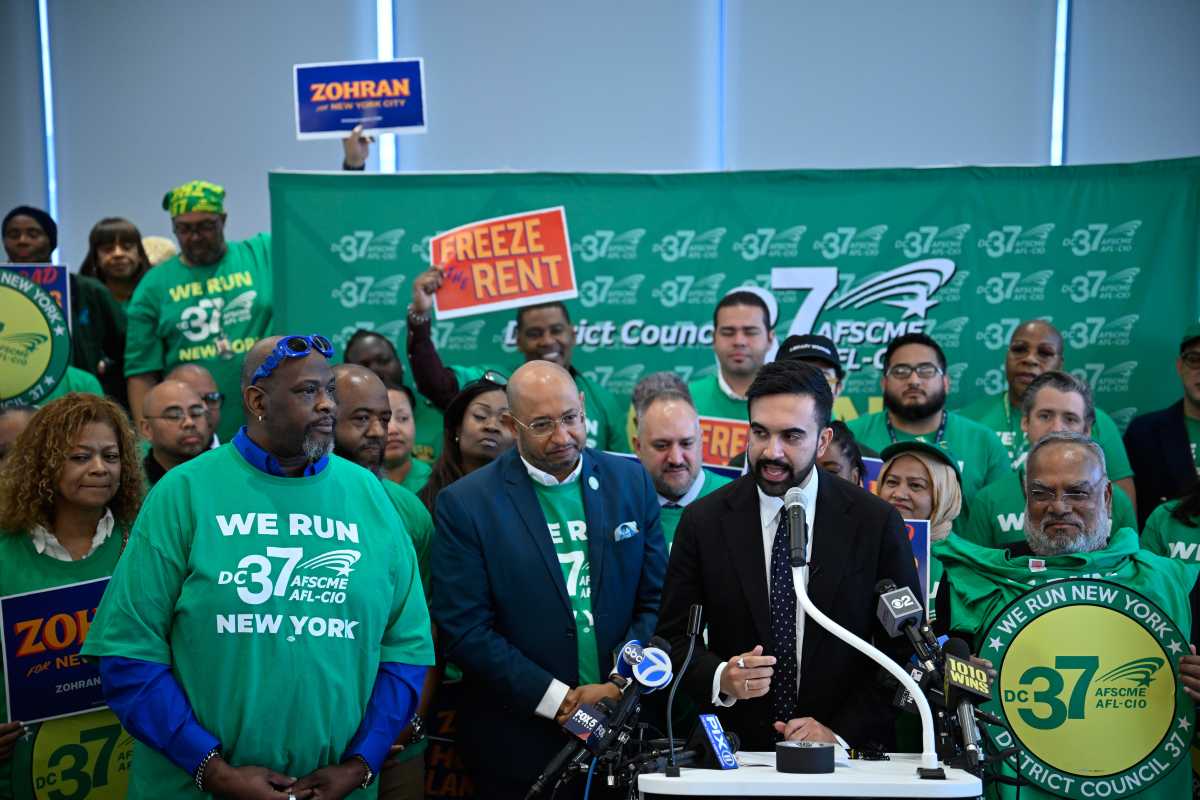
Democratic mayoral nominee Zohran Mamdani rallies with District Council 37 members after the union endorses him. Tuesday, July 15, 2025.
Photo by Lloyd Mitchell
There is no sharper example of what’s broken in today’s economy than when someone working a full-time job doesn’t even come close to earning what it costs to live in our city.
Here’s the tough truth: Hard work no longer means economic mobility in New York City today.
The cost of meeting daily, basic needs for a single adult —rent, utilities, transportation, groceries, health care—has risen to $60,000 a year, or $29 per hour for someone working a full-time job. That rises to $71,000 when you factor in other basics like debt and savings for a rainy day and retirement.
Millions of New Yorkers are piling up debt to pay for groceries each week, living paycheck to paycheck, one unexpected crisis away from disaster.
As a new mayor committed to making New York City affordable takes office and as the upcoming state budget session and election season get underway, we have a rare chance to come together and fix what’s broken.
Twelve years ago, on the heels of another upset election that swept a progressive into City Hall, we helped pass mandatory paid sick leave and implement a “living wage” for city-backed services and projects.
We both fought for—and won—New York State’s last big increase in the minimum wage.
And we’ve worked together to secure pay equity for long-overlooked workers in early education and other critical fields.
Our advice to mayor-elect Mamdani, and all our officials here in the city and up in Albany is simple: Think big.
The mayor-elect’s campaign started an urgently needed conversation about raising the minimum wage across New York State to $30 per hour. We’re both big supporters and the time to start pushing for that transformation is now, because it won’t happen overnight or without a sustained political fight.
But raising the minimum wage is just one piece of a more holistic agenda to help New Yorkers reach real economic security.
Let’s start with something government can directly control: the wages of nearly one million New Yorkers across our state who work in the human services sector, most of whom are paid through state contracts or with state funds.
These are the people who take care of our kids while we work, who make sure our elderly parents have someone at home they can lean on for help, who counsel our teens or who look after group homes for people living with addiction or developmental disabilities.
At some point, all of us rely on one of these workers to make our own lives work.
Yet wages for these workers leave one in six living in poverty according to the official poverty measure, and hundreds of thousands more far below the true cost of economic security. Because of low pay, the workforce turns over constantly.
As part of the Bring Up Minimum Pay (BUMP) campaign, we’re fighting for legislation in Albany that establishes a wage floor, raising the base pay across the entire non-profit social service sector to $29 per hour and requiring an annual cost-of-living adjustment
A newly released CUNY Institute for State and Local Governance report found that setting a new wage floor for human service workers would pull 100,000 New Yorkers out of poverty and pump $23 billion into the state’s economy—a win-win.
We can show we are serious about raising the minimum wage for everyone if we lead by example, working with the state legislature to pass BUMP in the 2026 session as a way to build momentum for more sweeping change for all workers.
The incoming mayoral administration can make a new wage floor a priority for its first budget and in its union contract negotiations, too.
There are still essential workers paid by the city, many of them union members, who earn too little to afford the city they serve. Truly tackling affordability means taking a bottom-up approach that lifts up these lowest-paid workers in the first months of a new term.
Critics once predicted that things we now take for granted like paid sick days or an increased minimum wage would bankrupt the state and city. They were wrong, and today’s workers and all New Yorkers are better for it.
We can’t rest on past progress. We need to do our part, here and now, to lift up hardworking childcare workers, home health aides, nursing assistants and all the people who make this city work for the rest of us.
Voters endorsed a bold agenda this past November. We can forge a new partnership with City Hall and Albany to deliver that change for all working people.
Henry Garrido is the executive director of District Council 37. Jennifer Jones Austin is CEO of the Federation of Protestant Welfare Agencies.